

Start with the only sentence in this article that comes from someone with no bottle to sell you.
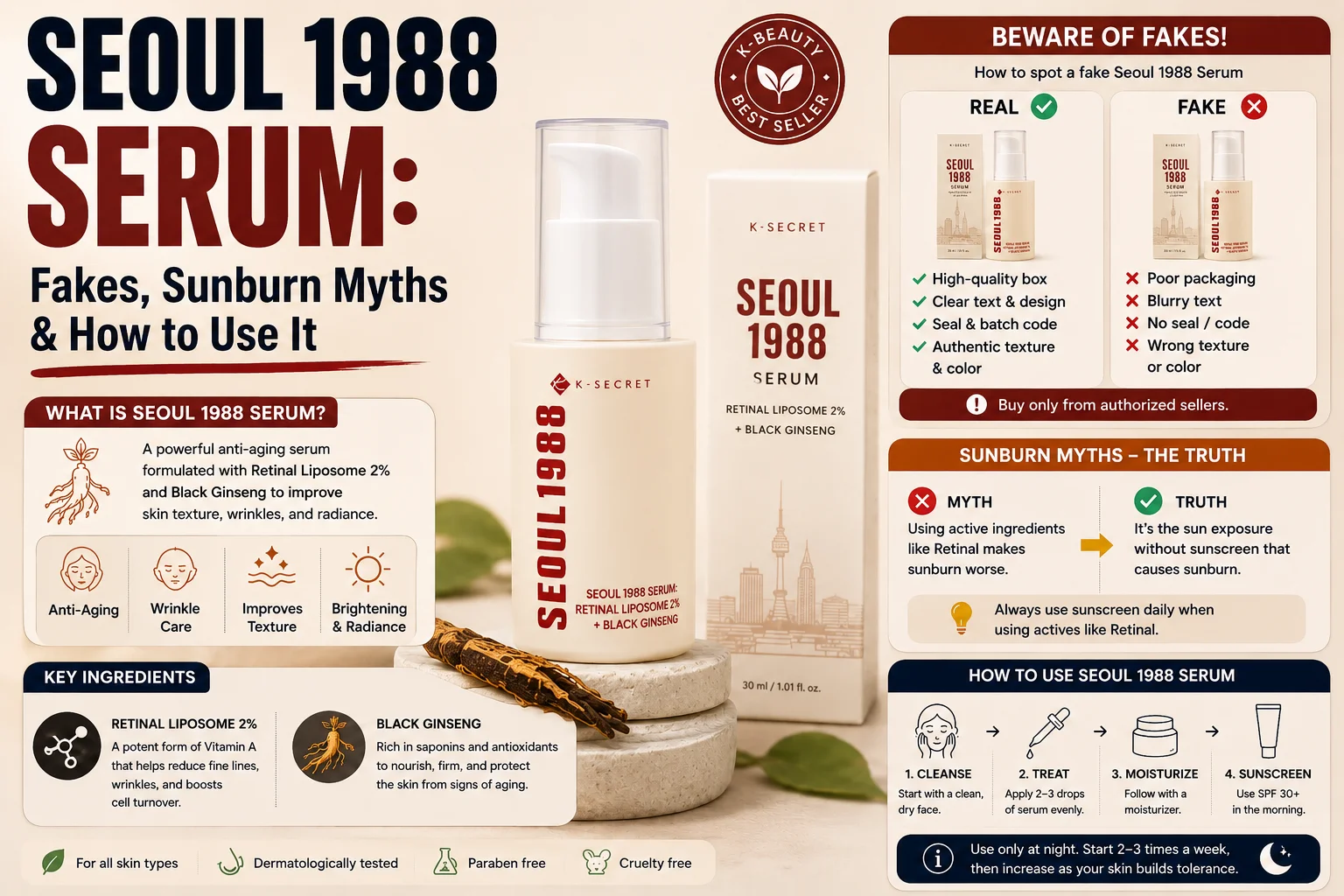
K-Secret, the brand that makes the Seoul 1988 serum, says on its own site that it has become aware of counterfeit products falsely claiming to be made by K-Secret being sold worldwide. It says those fakes don't meet its quality standards and may cause skin irritation or serious damage. And it adds the line that matters most: it cannot guarantee the safety or quality of anything bought outside its official sales channels.
That's the manufacturer, in writing. Not a TikTok seller. Not a shop's blog post. The brand.
So yes — the fakes are real. Now here's the part nobody tells you.
Almost every "how to spot a fake" guide is made by someone selling the real one
Go looking for authentication advice and you'll find dozens of videos and posts. Real vs fake. Original vs counterfeit. Check the packaging.
Read the captions.
"I only sell the authentic Korean version." "Every product is sourced through verified channels." "Recognized as an official retailer." "Do inbox us if you want more videos like this."
These aren't consumer warnings. They're conversion funnels. The counterfeit panic is genuinely useful to anyone with inventory, because the solution to it is always, conveniently, buying from them.
That doesn't make them liars. Some of them are authorized sellers doing a public service. But it means the "authentication markers" circulating online are being produced by people whose incentive is for you to distrust everyone else — and the markers themselves conflict, because of the next problem.
The packaging changed, so "old packaging = fake" is wrong
This is the trap that will cost readers money.
K-Secret updated the Seoul 1988 packaging. Sellers describe it directly — new packaging with the volume printed on the product, and a raft of "old and new packaging" comparison videos to match.
Which means a bottle that doesn't look like the current official photos might be counterfeit. Or it might be legitimate older stock sitting in a warehouse. There is no way to tell those apart from a comparison video, and every guide that tells you "if it looks like this, it's fake" is quietly assuming otherwise.
If you throw out a real bottle because it has last year's box, congratulations: the counterfeit panic cost you exactly what the counterfeit would have.
What actually works: check the list, not the box
Skip the forensics. Do the boring thing.
K-Secret maintains a page of official stores and authorized sellers, broken down by country. Its own guidance is simply to buy only from the sellers on that list. Internationally that includes YesStyle, StyleKorean, Stylevana and Jolse; in Canada, retailers including KBeauty Canada, Kiokii and…, and Kiyoko Beauty. There are more, organised by region.
I'm deliberately not reproducing the full list here, and you shouldn't trust any article that does — including this one. Distribution changes. A list that's right in July is wrong by December, and a stale list published by a magazine is exactly the kind of thing a counterfeit seller loves to screenshot. Go to K-Secret's authorized-seller page and check it on the day you buy.
If a seller isn't on that page, the brand has told you plainly it won't stand behind what's in the bottle. That's the whole test. It takes ninety seconds and it's more reliable than every packaging comparison on the internet combined.
Red flags that hold up regardless: prices well below every authorized seller, missing batch information, and packaging that differs from official brand photos in the current listing on an authorized site — not from a stranger's screenshot.
Now the myth that could actually hurt you
A lot of people are searching whether this serum can clear sunburn. It's one of the most common questions attached to the product.
Before answering it, we have to ask which sunburn you mean — because the word does two different jobs depending on where you live.
If you mean an actual burn — red, hot, tender, maybe peeling, from too long in the sun — then no. Emphatically. Don't.
Retinal is a vitamin A derivative. Its job is to accelerate cell turnover. Sunburned skin is acutely inflamed with a compromised barrier, which is the exact condition under which any active ingredient stings hardest and helps least. There is no mechanism by which speeding up turnover soothes a burn; you're applying an irritant to skin that is already injured. Acute sunburn wants cool compresses, bland moisturiser, and time. If it's blistering, covers a large area, or comes with fever or chills, that's a doctor, not a serum.
If you mean the darker patches the sun left behind — which is how "sunburn" is often used across much of West and Southern Africa and South Asia, where a lot of this search volume originates — then the answer changes to "maybe, slowly, and only with sunscreen."
That's a real and different question, and it's the one this product is arguably built for. The formula pairs retinal with niacinamide, bakuchiol, peptides and a vitamin C derivative, and the brand pitches it at dark spots and uneven tone. Over months, that's a plausible ask.
But there's a catch that flips the whole thing. Retinal makes skin more sensitive to sunlight, and it keeps working during the day. Use it and skip sunscreen and unprotected UV can deepen pigmentation — quietly undoing the brightening you're paying for. People who report the serum made their face darker are usually describing this, not a bad batch.
No sunscreen, no serum. Not a suggestion. The product doesn't work without it.
[EDITOR: dermatologist quote goes here — ideally someone who treats melanin-rich skin, on why retinoids and acutely inflamed skin don't mix, and on the sun-sensitivity/PIH loop. This section is written to stand without it, but it's much stronger with a named clinician.]
"2% retinal" is not 2% retinal
Here's the detail that reframes almost every complaint about this product.
The label says Retinal Liposome 2%. That is not the same as two percent retinal. The 2% refers to the liposome dispersion — the encapsulation system. The actual pure retinal content works out to around 0.02%.
Two percent would be an extraordinary, borderline dangerous concentration for a consumer serum. 0.02% is a low, beginner-friendly dose. Check the ingredient list and it tracks: retinal appears well down the INCI, below the macadamia oil.
This explains two things at once. It explains why the brand positions it as suitable for sensitive skin and first-time retinoid users. And it explains why people expecting prescription-tretinoin results in three weeks are disappointed — you're not using a sledgehammer, and it was never sold as one.
Purging vs. breaking out
If you break out in the first few weeks, the useful question is where.
Purging happens where you already break out. Retinal accelerates turnover, so congestion that was going to surface anyway surfaces faster and all at once. It's short-lived and it settles.
A reaction shows up somewhere you don't normally break out, or arrives with burning, stinging, or flaking that doesn't calm down.
The rough dividing line most people use is three to four weeks. Past that, it isn't purging.
But note the two other explanations that get blamed on the formula and shouldn't be. If your barrier is already damaged — from over-exfoliating, or from harsh bleaching creams — almost any active will sting it, and the fix is repairing the barrier first and reintroducing the serum slowly. And a counterfeit, per K-Secret's own warning, may contain irritating fillers that aren't in the real formula at all.
Same symptom. Three completely different causes. Only one of them is the product.
How the brand actually says to use it
Straight from K-Secret's own usage guidance, which contradicts a decent chunk of what's circulating:
Night, not morning. Retinal may oxidise when exposed to sunlight. If you do use it in the day, sunscreen is mandatory.
Start at twice a week for the first one to two weeks, then increase gradually as your skin adjusts. The people who wreck their barrier are almost always the people who started daily.
Pea-sized, on dry skin, face and neck, then moisturiser.
The sandwich, if you're sensitive: moisturiser, serum, moisturiser.
Store it cool and shaded. Retinal degrades in light and heat. The fridge is a real option, not a TikTok affectation.
Not during pregnancy or breastfeeding. Standard guidance for retinoids. If you're pregnant, this is a conversation with your doctor, not a comment section.
The honest bottom line
The counterfeits are real, and the brand says so itself. But the fake-spotting economy that's grown around them is mostly people selling bottles, and the packaging changed, so the folk wisdom is unreliable in both directions.
Check the authorized-seller list. Wear sunscreen. Start twice a week. Don't put it on a burn.
That's the entire article, and none of it requires you to squint at a box.

















Comments 0
Leave a Comment
💬
No comments yet. Be the first to share your thoughts!