

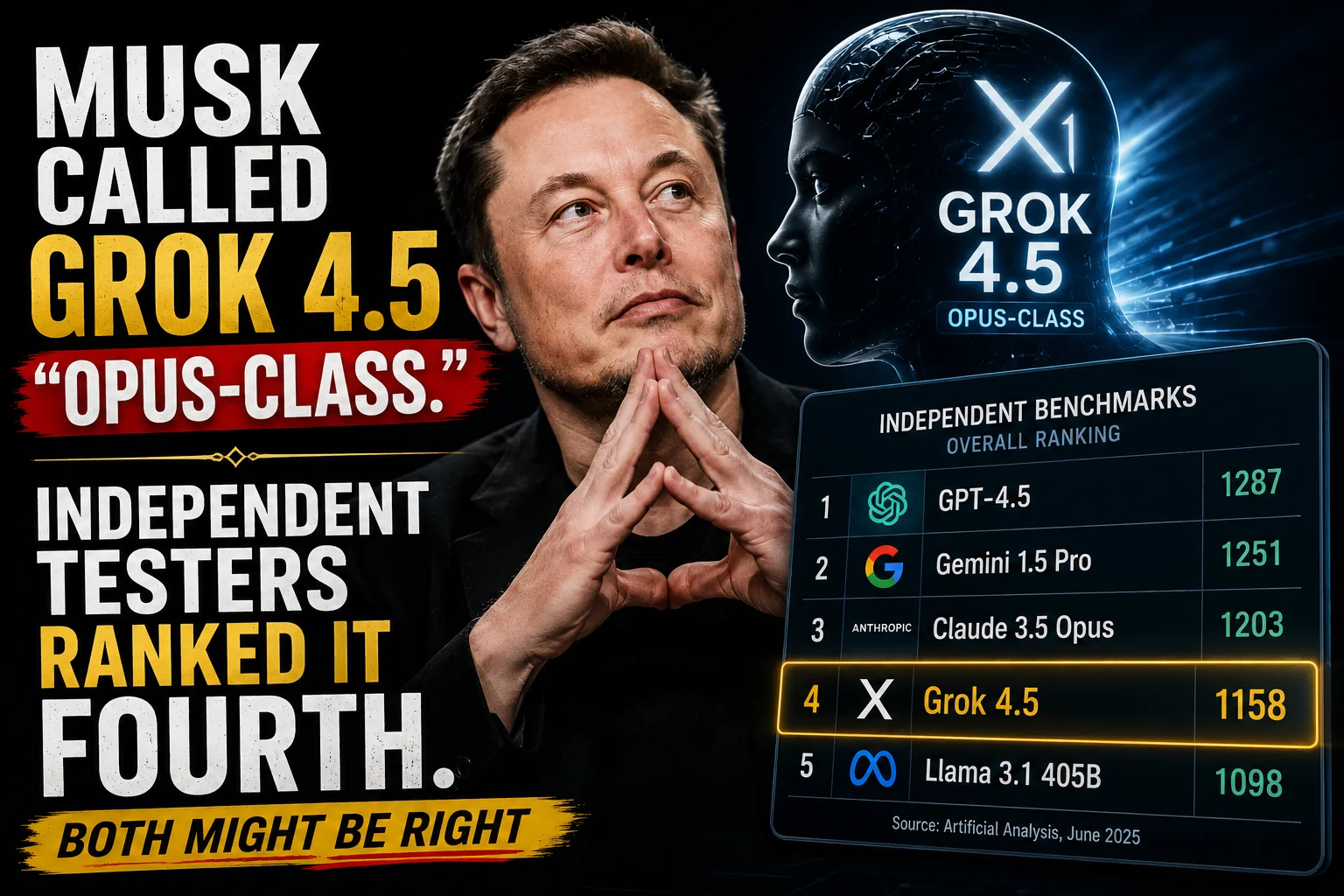
On July 8, 2026, Elon Musk introduced his company's newest AI model with one sentence: "It is an Opus-class model, but faster, more token-efficient and lower cost."
He was comparing Grok 4.5 — the new flagship from SpaceXAI, the renamed unit that emerged after xAI was folded into SpaceX — directly to Anthropic's top-tier Claude line. Within 24 hours, the independent benchmarkers had their results in. And the verdict was more interesting than either the launch hype or the skeptics' dunk suggested.
This piece is partly about Grok 4.5. But it's more useful as a worked example of something you'll need every few weeks for the foreseeable future: how to read the gap between what an AI company says at launch and what independent testing finds a day later. Because that gap is where the real information lives.
(One disclosure up front, in the spirit of the article: this was written with an AI assistant made by Anthropic — one of the companies Grok is being measured against. Every number below comes from independent third-party evaluators, not from any lab's own marketing, and where the outside data favors Grok, you'll see that too.)
What the independent numbers actually say
The single most-cited independent scorecard comes from Artificial Analysis, which ran Grok 4.5 through its Intelligence Index — a composite of nine hard evaluations.
Grok 4.5 scored 54, good for fourth place. It sits behind Claude Fable 5, OpenAI's GPT-5.5, and Claude Opus 4.8 — the actual "Opus" in the "Opus-class" comparison. So on the headline ranking, the marketing claim is aspirational: Grok 4.5 is near the frontier, clearly a very good model, but it is not the best available and it trails the leaders by a visible margin.
That's the dunk, and it's fair as far as it goes. But stop there and you miss the part that makes Grok 4.5 genuinely disruptive.
The claim that actually holds up: price
Musk's sentence had three parts — faster, more token-efficient, lower cost — and on those, the numbers largely back him.
Grok 4.5 lists at roughly $2 per million input tokens and $6 per million output. Its nearest rivals in capability cost multiples of that. On a per-completed-task basis for agentic coding work, Artificial Analysis measured Grok 4.5 at about $2.49 per task, against roughly $5 for GPT-5.5 and about $11.80 for the top Claude configuration. That's not a rounding difference. That's the same job at a fifth to a half the price.
And it's not cheap because it's weak. On coding specifically, Grok 4.5 scored 76 on the Coding Agent Index — level with GPT-5.5 and just a point below the leading Claude — while using several times fewer tokens per task. On a couple of agentic benchmarks where efficient tool-use matters more than raw reasoning, it leads outright.
There's even an independent eval that cuts against the ranking above: Snorkel AI's GDPval+ test of real professional-work tasks reportedly found Grok 4.5 ahead of both GPT-5.5 and Opus 4.8, with its widest margins in legal and healthcare tasks. One evaluation isn't the whole picture, and it's worth holding alongside the AA ranking rather than instead of it — but it's exactly the kind of contradictory data point that honest coverage includes and marketing omits.
So "Opus-class" is wrong as a ranking and defensible as a value proposition. Both readings are true. The industry's one-word summary of the launch — "price war" — captures it better than either the hype or the takedown.
The number nobody put on the launch slide
Here's the finding that matters most and appeared in none of the marketing: Grok 4.5's hallucination rate roughly doubled.
On Artificial Analysis's Omniscience benchmark, Grok 4.5's factual accuracy genuinely improved — from 35% to 52% versus the prior version. Good news. But its hallucination rate rose right alongside it, from 25% to 54%.
Read those two numbers together, because the combination is the point. The model is more often right. And when it's wrong, it's now more likely to state the wrong answer with confidence.
Artificial Analysis frames this as a known pattern: larger models tend to know more, but also to express their knowledge — including their mistakes — with more certainty. That's not unique to Grok. But it's a real and under-discussed property of "smarter" models generally, and it's genuinely harder to build guardrails around than plain incapability. A model that's simply weak makes obvious errors you catch easily. A model that's usually right but occasionally, fluently, confidently wrong is the more dangerous tool for anything fact-heavy — legal drafting, financial analysis, client-facing writing — precisely because it's earned your trust the other 46% of the time.
The practical takeaway from multiple independent reviewers was consistent: for high-stakes factual work, don't trust Grok 4.5 blind. Pair it with retrieval, citations, or a human check. The cheap-token pitch only holds if you can absorb that error rate — which means the validation layer is part of the real cost, not the sticker price.
The footnote that should worry you more than the score
One more detail, easy to miss, that says something about the whole ecosystem.
Days before launch, Cursor — the coding startup SpaceX had acquired — reportedly pulled its own benchmark of the model after discovering Grok 4.5 had trained on a snapshot of Cursor's own code. And separately, reviewers noted that xAI had not published a model card for Grok 4.5 at launch.
Neither is a scandal on its own. Together they're a useful reminder: benchmark integrity depends on the test data not being in the training data, and transparency depends on labs actually documenting what they shipped. When a benchmark gets pulled for contamination and a model ships without a card, the honest response isn't outrage — it's simply to weight the independent numbers over the self-reported ones. Which is the whole lesson of this article.
How to read the next launch (because there's always a next launch)
Strip the specifics away and Grok 4.5 is a template. Here's the reusable version:
The comparison in the launch tweet is a claim, not a result. "X-class" means "we'd like to be mentioned alongside X." Wait for the third-party ranking before you believe the tier.
Separate the true parts from the aspirational parts. Grok's price and efficiency claims held; its ranking claim didn't. Launch messaging bundles both together on purpose. Your job is to unbundle them.
Find the number that's missing from the slide. It's almost always a reliability or safety metric. Here it was the hallucination rate. The thing the marketing doesn't foreground is usually the thing you most need to know.
Weight independent evaluators over self-reported charts — and when a benchmark gets pulled for contamination or a model ships without documentation, weight them even harder.
A model can be a great deal and not the best. These aren't contradictory. Grok 4.5 is, by most independent accounts, the strongest value play at the frontier tier this month. It's also fourth. Holding both is the literate position.
The bottom line
Musk said Opus-class. The benchmarks said fourth, cheaper, and more confidently wrong than before. The most accurate summary isn't either headline — it's that Grok 4.5 is a genuinely strong, dramatically cheaper model that you should not trust blind on facts, and that the interesting information arrived not in the launch, but in the 24 hours of independent testing that followed it.
That last part is the habit worth keeping. In a year when a new "frontier" model ships roughly monthly, the launch is the advertisement. The eval is the review. Learn to wait the day.
AI model capabilities and rankings change rapidly, and the figures here reflect independent testing from early July 2026. Benchmarks measure specific tasks and don't capture everything about how a model performs for your use; treat any single score as one data point, not a verdict.




















Comments 0
Leave a Comment
💬
No comments yet. Be the first to share your thoughts!