
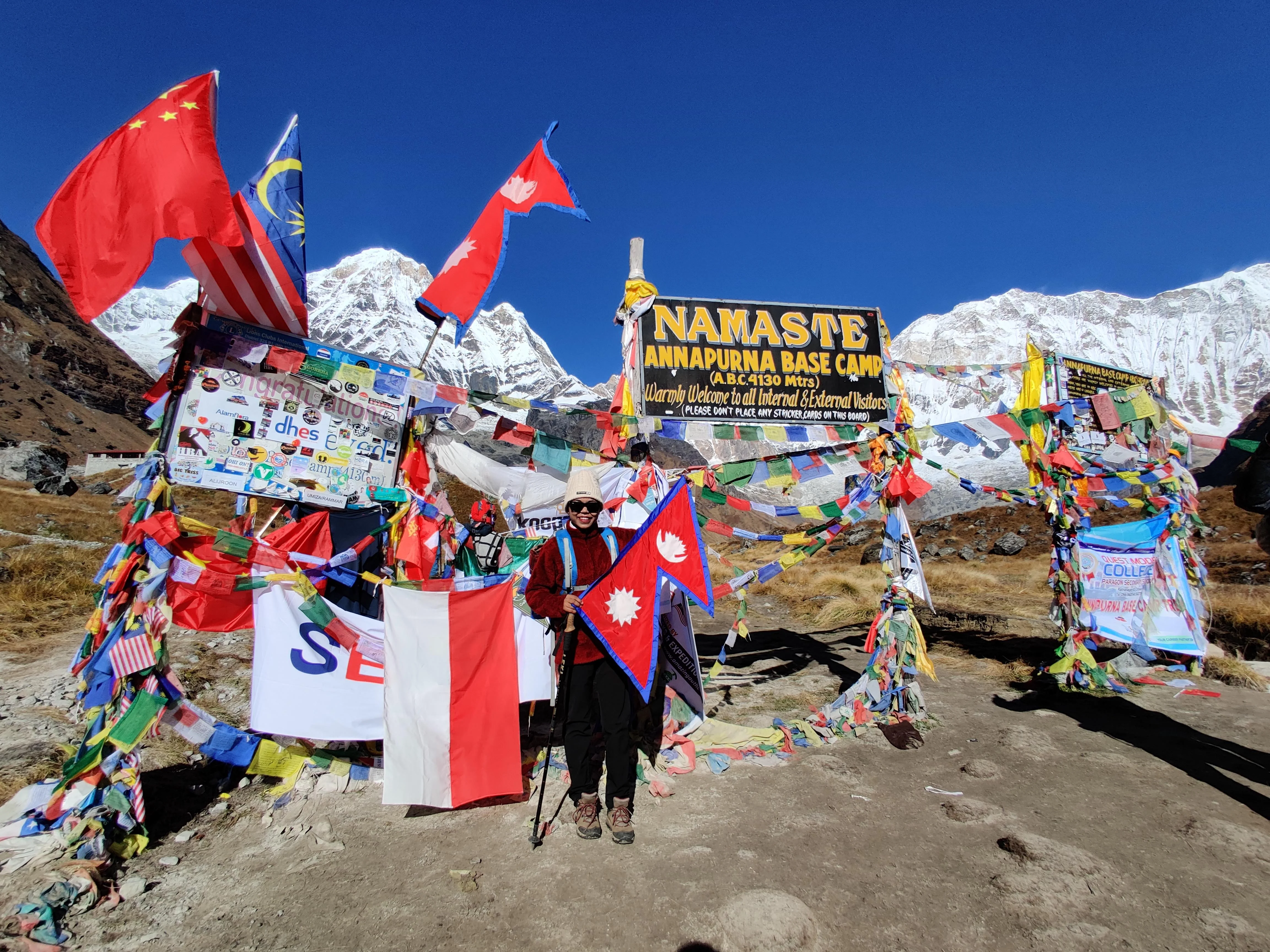

Nepal is home to the Annapurna Base Camp (ABC) trek, one of the most popular trekking routes on the planet, and once you're on the trail it's easy to see why. The route runs through the Annapurna Conservation Area, the biggest and the first conservation area established in Nepal, and it serves as the gateway into the Annapurna Himalayas, where the trail eventually climbs past 4,000 meters to stand directly beneath Annapurna I (8,091m), the world's 10th highest mountain.
What makes ABC different from Nepal's other classic treks is how much variety is packed into a relatively short walk. You start low, in warm, terraced farmland, and within a matter of days you're standing in a glacial amphitheater surrounded by peaks on every side. In between, the trail passes through villages like Ghorepani, Tadapani, and Chhomrong, each with its own distinct character and culture. This is a region shaped by several different ethnic communities — Gurungs, Magars, Thakalis, and Lobas — and walking through their villages means walking through their kitchens, prayer flags, and daily routines as much as their scenery. Teahouses along the way serve genuinely good Nepali food, and skipping the chance to try dal bhaat, thukpa, or momo cooked at 3,000 meters would be a missed part of the experience.
The landscape itself does a lot of the storytelling. Lower down, you walk through bright green terraced fields carved into the hillsides by generations of farmers. As you climb, the terraces give way to dense rhododendron and pine forest — usually the most photographed section of the trek when the rhododendrons bloom in spring. The Modi Khola river runs alongside much of the route, sometimes a quiet trickle, sometimes a genuinely powerful glacial torrent crossed on swinging suspension bridges. Eventually the forest thins out entirely, the air gets noticeably thinner, and the trail opens into bare rock and moraine before the final approach to base camp, where snow-capped walls rise up on all sides. Few treks in Nepal manage this much ecological and cultural range in under two weeks, which is exactly why ABC remains one of the most recommended routes for first-time trekkers and seasoned hikers alike.
Top Highlights of Annapurna Base Camp
- Experience the scenic drive from Kathmandu towards the vibrant city of Pokhara
- Visit the Annapurna Conservation Area, the first and largest conservation area in the country
- Walk past lush green terraced farms, tumbling waterfalls, and unspoiled forest
- Witness incredible sunrise views over Dhaulagiri, Annapurna South, and the wider Himalayas from the Poon Hill lookout point
- Interact with friendly locals, mainly Gurungs, Tamangs, and Magars
- See some of the highest peaks in the world, including Dhaulagiri I (8,167m, 7th highest) and Annapurna I (8,091m, 10th highest)
- Relish traditional Nepali food like dal bhaat, thukpa, or momo at teahouses along the route
- Capture stunning mountain and glacier scenery while standing at Annapurna Base Camp itself
- Unwind at Jhinu Danda's natural hot springs after crossing one of the trek's longest suspension bridges
- Celebrate reaching 4,130m with your trekking group, standing beneath some of the tallest mountains on earth
Route Overview
Your Annapurna Base Camp adventure effectively starts the moment you land at Tribhuvan International Airport (TIA). If you've arranged a pickup, you'll usually be met by someone holding a name sign, ready to help you settle in before the trek even begins — a small detail, but one that takes a lot of the stress out of arriving in a new country.
From Kathmandu, most itineraries begin with a scenic drive or short flight to Pokhara, the lakeside city that serves as the launchpad for the entire Annapurna region. It's worth spending an evening here before the trek starts — a walk along Phewa Lake's shoreline, a good meal, and an early night go a long way toward starting the trek well-rested. The next morning, a drive to Nayapul marks the real beginning of the route. From here, the trail winds through forest, past small waterfalls, and along stretches of river where locals still stop to bathe or wash clothes. The first proper trekking day usually ends in a village like Tikhedhunga or Ulleri — high enough that the noise of the road is already gone, replaced by the quiet of the hills and, often, a genuinely spectacular star-filled sky.
From there, the days settle into a rhythm: early starts, steady climbs through forest and village, long lunches over dal bhaat, and evenings spent comparing notes with fellow trekkers over card games or tea. The trail gains height gradually, passing through Ghorepani (with its optional pre-dawn detour up Poon Hill), Tadapani, and Chhomrong, before dropping into the Modi Khola valley and beginning the final push toward Machhapuchhre Base Camp and, a few hours later, Annapurna Base Camp itself. Coming back down is faster — most itineraries cover in two days what took four or five on the way up — with a stop at the Jhinu Danda hot springs offering a well-earned soak before the drive back to Pokhara.
Notes:(Shorter 7-day itineraries skip Poon Hill; longer versions add acclimatization days.)
















Comments
✏️ Drop your thoughts
No comments yet. Be the first to share your travel experience!