

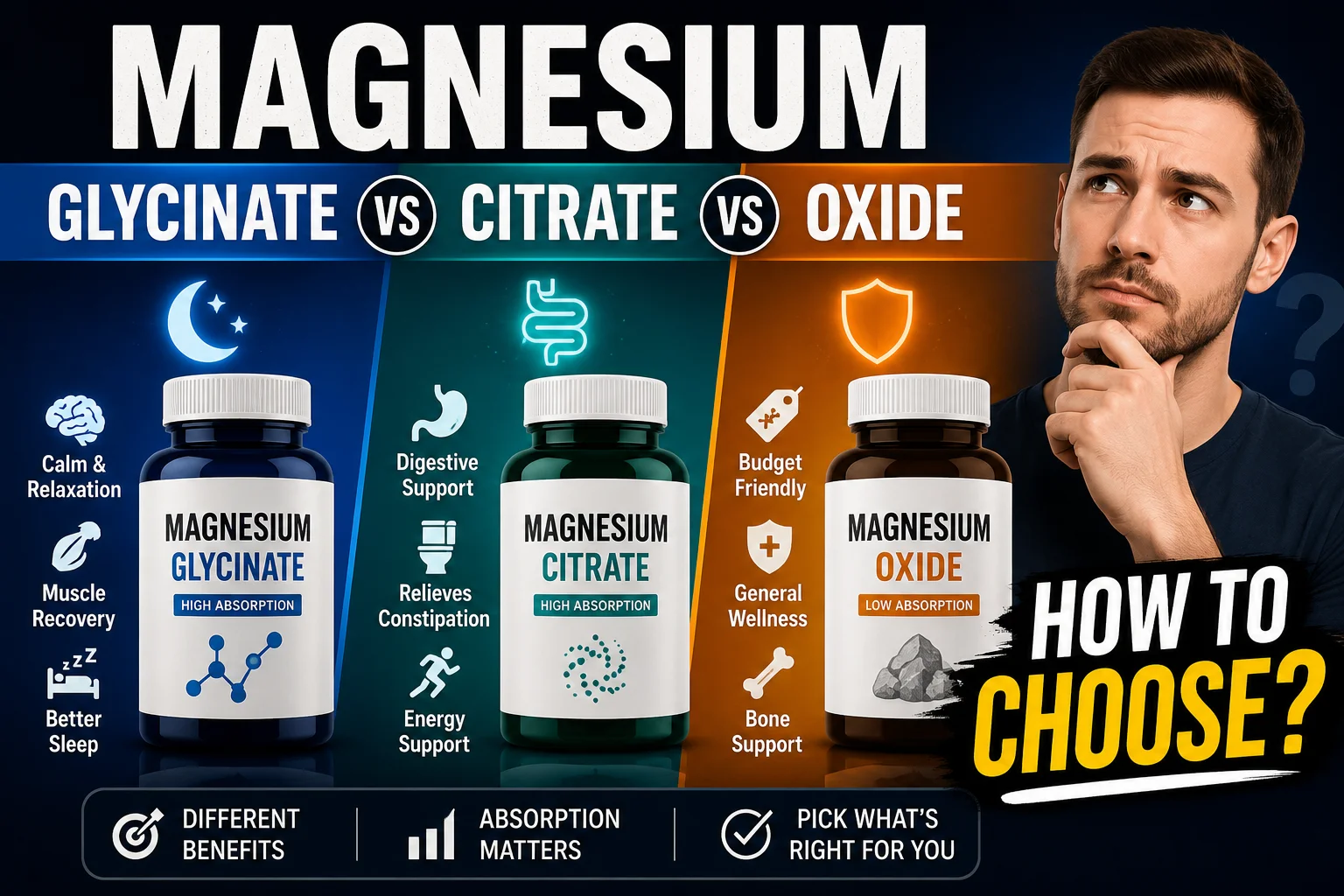
Stand in the supplement aisle and the magnesium section is a wall of nearly identical bottles separated by a single word: glycinate, citrate, oxide, malate, threonate, taurate. The marketing implies these are specialized tools for specialized jobs, and that the cheap ones are compromises.
Here's the honest version, which is less exciting than the labels: one thing about the form genuinely matters — how much magnesium your body actually absorbs — and on that single point, oxide is genuinely poor while glycinate and citrate are genuinely good. Almost everything past that — the precise absorption percentages, the dramatic sleep-and-anxiety numbers, the form-specific miracles — rests on shakier ground than the packaging suggests.
So let's do the real comparison: what each form is for, where the evidence is solid, where it's marketing, and the label trick that makes the worst-absorbed form look like the best deal.
First, the number on the label is lying to you (a little)
This is the most useful thing in the article, so it goes first.
Magnesium is never sold on its own. It's always bound to something else — glycine, citric acid, oxygen — and that partner molecule changes two things: how much magnesium you actually absorb, and how your gut reacts. The weight printed on the front of the bottle is usually the weight of the whole compound, not the magnesium your body can use. The number that actually matters is elemental magnesium, and good labels list it separately in the supplement facts.
Why this matters in practice: magnesium oxide carries a very high percentage of elemental magnesium by weight, so its label looks impressive. But it absorbs terribly — often under 5–10%. Most of it passes straight through you. Meanwhile a chelated form like glycinate is bulkier and shows a smaller number, but far more of it lands in your bloodstream.
The consequence is genuinely counterintuitive: a "500 mg" magnesium oxide tablet and a "200 mg" magnesium glycinate capsule can deliver a similar absorbed dose, because the oxide gives up so little of what it holds. Chasing the biggest number on the shelf usually means buying the form your body uses least.
Absorption tracks with how well the form dissolves, not with how much magnesium the pill contains. Keep that one sentence and you've already beaten most of the aisle.
Magnesium glycinate: the gentle daily one
What it is: magnesium bound to glycine, an amino acid. (You'll also see it sold as magnesium bisglycinate — same thing.)
Why people pick it: two reasons, and it's worth being precise about which is real. First, it absorbs well and — this is the actual selling point — it's very gentle on the gut. You can take it every night without the loose stools that cheaper forms cause. Second, the glycine it's bound to has a mildly calming profile of its own.
What it's genuinely good for: anyone taking magnesium daily, and specifically anyone taking it for sleep or general relaxation. Here's the honest nuance most articles skip: glycinate dominates the sleep conversation not because it has some dramatic absorption edge over citrate — in head-to-head terms they land in a similar range — but because magnesium's sleep benefit comes from consistent daily intake, and glycinate is the form you can actually tolerate every single night. A form you take nightly beats a form you take three times a week because your gut needs a break from it.
The evidence check: the sleep data is real but modest, not miraculous. Randomized trials have reported small improvements in how fast people fall asleep and in subjective sleep quality — and the effect is strongest in people who were low in magnesium to begin with. If you're already replete, don't expect a sleeping pill. Interestingly, most of those trials actually used oxide, citrate, or mixed forms; glycinate is favored clinically mainly for glycine's calming effect and its tolerability, not because it's the one that was tested.
Magnesium citrate: the well-absorbed workhorse (that loosens your stool)
What it is: magnesium bound to citric acid.
Why people pick it: it's well absorbed, it's inexpensive, and it's the best-studied over-the-counter option. It's the sensible default for general magnesium replacement.
The catch, which is also a feature: at higher doses the unabsorbed fraction pulls water into your bowel, softening and speeding up stool within a few hours. That predictable mild laxative effect is why citrate is the go-to for occasional constipation and is even used to clear the bowel before a colonoscopy.
So the deciding factor between citrate and glycinate isn't absorption — it's your gut and your goal. Constipation part of the picture? Citrate is a two-for-one. Digestion already loose, or you just want daily magnesium without a bathroom schedule? Glycinate. That's the whole decision, most of the time.
Magnesium oxide: cheap, high on paper, poorly absorbed
What it is: magnesium bound to oxygen. The most common form in generic drugstore tablets.
The reality: high elemental magnesium by weight, low absorption — frequently cited under 5–10%. Most of it passes through unused, and at higher doses that unabsorbed magnesium can cause bloating or loose stools.
When it's actually fine: it's not useless. Because it's cheap and pulls water into the gut, it has a legitimate short-term role for constipation or heartburn. What it's not good at is efficiently raising your body's magnesium levels — so if your goal is correcting a shortfall or supporting sleep, it's the wrong tool, regardless of how big the number on the bottle looks.
One honest caveat, because the science isn't a cartoon: at least one study suggested oxide's uptake over the long term, especially on an empty stomach, is a bit better than the worst headline figures imply. It's poor, not zero. But "poor" is still the right word for the job most people are buying magnesium to do.
The other forms, briefly
The aisle has more: malate (sometimes pitched for energy and muscle), threonate (marketed heavily for brain and cognition, on genuinely preliminary evidence), taurate (promoted for heart health). The pattern to notice is that the marketing confidence tends to outrun the human data — the form-specific claims are usually built on small or early studies. For the overwhelming majority of people, the real choice is still glycinate vs. citrate, decided by your gut.
So which should you take?
The genuinely simple version:
For daily use or sleep, with a normal-to-sensitive gut ? glycinate. Gentle enough for every night, which is the whole point.
For general replacement, especially if you also get constipated ? citrate. Well absorbed, cheap, and the laxative pull is a bonus not a bug.
For occasional constipation or heartburn, short term ? oxide is fine and inexpensive. For raising low magnesium, skip it.
Chasing the biggest milligram number ? stop. Read the elemental magnesium figure instead.
The safety part, which actually matters
This isn't boilerplate — please read it.
For most healthy adults, supplemental magnesium is well tolerated, and the usual first sign of too much is loose stools. General guidance caps supplemental elemental magnesium around 350 mg per day for adults to avoid that (the total from food plus supplements is different, and food magnesium doesn't carry the same risk). Start low, take it with food if it bothers your stomach, and increase slowly.
But two situations change the math completely:
Kidney problems. Healthy kidneys clear excess magnesium easily. Impaired kidneys may not, and magnesium can build to genuinely dangerous levels. If you have any kidney condition, do not start magnesium without a doctor.
Medications. Magnesium can interfere with the absorption or action of several drugs — certain antibiotics and osteoporosis medications among them — and can interact with others. If you take prescription medication, check with a pharmacist or doctor first; a pharmacist is free to ask and does this all day.
And the point people skip toward when they're self-treating a symptom: if you're reaching for magnesium because of ongoing anxiety, insomnia, muscle problems, or persistent constipation, those can have underlying causes a supplement won't fix and might mask. Magnesium is a reasonable thing to try for mild issues; it's not a substitute for finding out why a persistent symptom is happening.
The bottom line
Most of the magnesium aisle is one real fact wearing a lot of marketing. The real fact: form determines absorption, oxide is poor at it, glycinate and citrate are good. After that, you're not choosing between a sleep magnesium and a digestion magnesium so much as choosing based on how your gut handles it — glycinate to take nightly in peace, citrate if a little laxative help is welcome, oxide for cheap short-term bowel duty.
Buy for the elemental number, match the form to your gut, start low, and — if you have kidney issues or take medication — ask first. That's the entire science, minus the packaging.
This article is general information, not medical advice, and doesn't replace guidance from your doctor or pharmacist about your specific situation. If you have a health condition, take medications, are pregnant or breastfeeding, or have persistent symptoms, talk to a healthcare professional before starting any supplement.

























Comments 0
Leave a Comment
💬
No comments yet. Be the first to share your thoughts!