

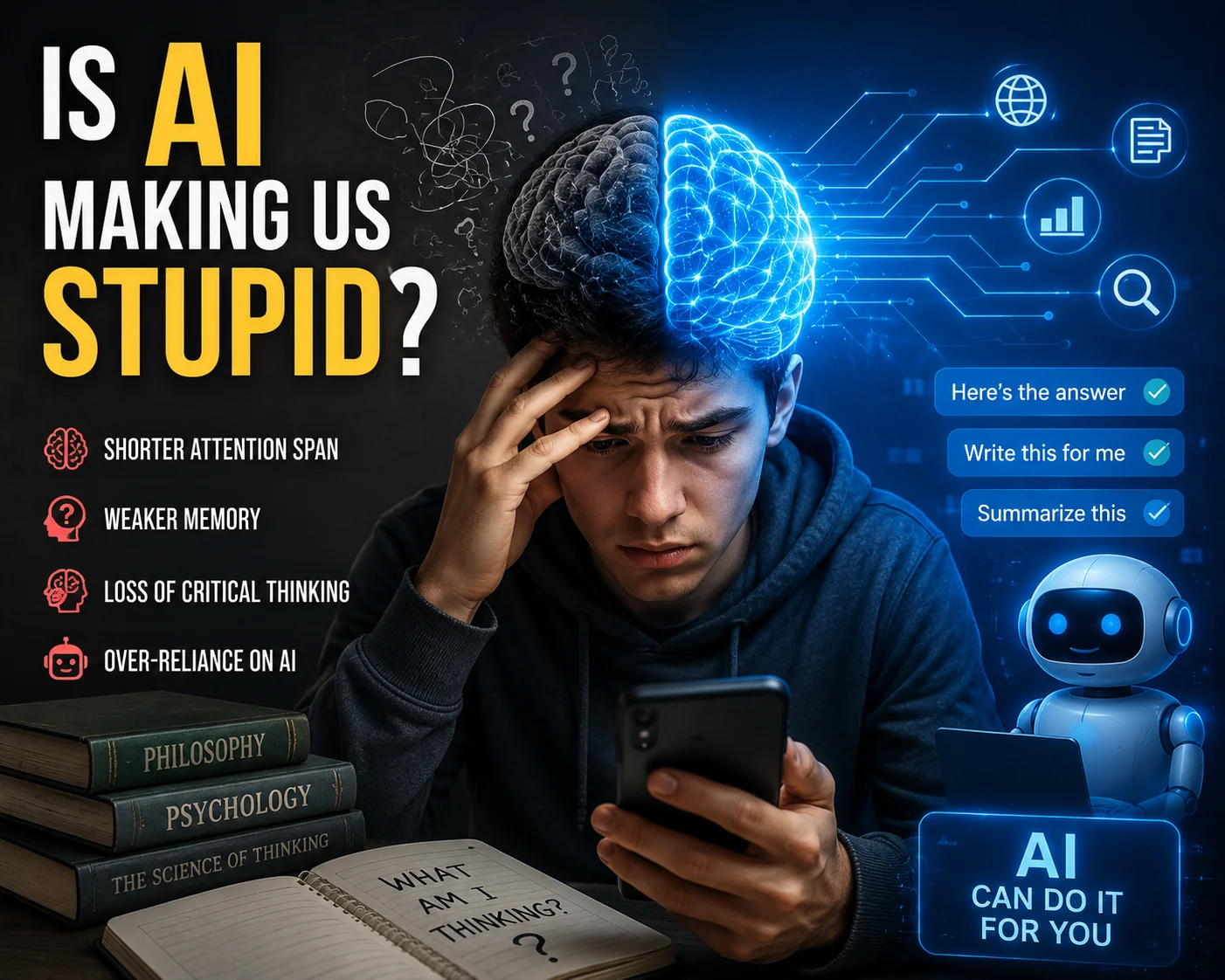
Two things are true at once, and the internet has decided to only tell you one of them.
The first: there is real, peer-adjacent research showing that when people lean on AI to think for them, they engage their brains less and remember less of what they produced. That's not a scare story. It's measured.
The second: almost every viral version of that research has stretched it past what it can bear. "MIT proves ChatGPT rots your brain" is not what MIT found, and the lead researcher has spent months saying so.
If you're a parent, a teacher, or a student who typed some version of "is AI making us stupid" into a search bar at midnight, you deserve the actual answer, not the panic and not the shrug. So let's go through what the studies really say, where the worry is legitimate, and where it isn't.
The study everyone's quoting
In mid-2025, researchers at MIT's Media Lab published a paper with a title engineered to travel: "Your Brain on ChatGPT: Accumulation of Cognitive Debt when Using an AI Assistant for Essay Writing Task."
Here's what they did. They took 54 university students from the Boston area and split them into three groups to write SAT-style essays: one used ChatGPT, one used Google (no AI summaries), one used nothing but their own head. Each did three sessions the same way. Then, in a fourth session, they flipped some people — ChatGPT users had to write with no tools, and the no-tools group got ChatGPT. Throughout, EEG caps recorded brain activity across 32 regions.
The findings, stated plainly:
Brain connectivity scaled down with the amount of help. The no-tools group lit up the strongest, widest neural networks. The search-engine group was in the middle. The ChatGPT group showed the weakest coupling — the least of the kind of cross-brain activity associated with deep engagement.
The AI group also struggled to quote their own essays afterward, and reported feeling less ownership of them. Two English teachers who read the essays found the AI-assisted ones strikingly similar to each other and, in a word that stuck, "soulless." And by the third session, many ChatGPT users had essentially given up thinking — handing the prompt over and asking for the finished essay. As the lead author, Nataliya Kosmyna, described the drift: it became "just give me the essay, refine this sentence, edit it, and I'm done."
That's genuinely unsettling, and it's the part the headlines got roughly right.
What the headlines left out
Now the caveats the viral posts skipped — and they matter enough that leaving them out changes the meaning.
The sample is 54 people. And really 18. Fifty-four did the first three sessions; only 18 came back for the crossover fourth session that produced the most dramatic "they got worse" finding. That's a very small group to hang a civilizational claim on.
It has not been peer reviewed. Kosmyna released it anyway, deliberately, because she felt the stakes justified getting it into the conversation. That's a defensible choice. It's also a reason to hold it a little more loosely than a published, replicated result.
The task was 20 minutes long. These were brief essay sessions over a few months, not a longitudinal study of developing minds. The paper does not — cannot — show permanent damage or long-term intellectual decline. Even sympathetic analysts who dug into it were careful on this: it suggests passive AI use can impair learning in the moment. It does not prove AI turns your brain to mush.
Kosmyna herself has begged people to stop overstating it. She's been explicit that the paper does not say AI makes you stupid, and that headlines claiming so are misrepresenting the work. When the author of the scary study is the one pumping the brakes, that tells you something.
So: a real signal, a small and preliminary study, and a finding that's been inflated well past its evidence. Hold both.
The second study, which is quieter and maybe more important
The one that got less attention is arguably the more useful, because it's about adults doing real work, not students doing homework.
In early 2025, Microsoft Research and Carnegie Mellon surveyed 319 knowledge workers about 936 actual instances of using generative AI on the job. They asked, in effect: when you use AI, do you think harder or less hard — and when do you bother to check its work?
The effort numbers are striking. Workers reported needing "less" or "much less" mental effort in a large majority of cases — on the order of 72% for knowledge tasks, 79% for comprehension, 76% for synthesis. On its face, that's just efficiency, which is the whole point of the tool.
But the finding that should stay with you is about confidence. The more someone trusted the AI, the less critical thinking they did. The more someone trusted their own expertise, the more they scrutinized the AI's output.
Read that twice, because it inverts what most people assume. The danger zone isn't the expert using AI. It's the novice — the person who doesn't yet know enough to catch the AI when it's wrong, and who trusts it precisely because they can't evaluate it. As the researchers put it, workers often skip critical thinking exactly when they lack the skills to inspect and improve what the AI gives them.
That study has critics too, and fair ones — it's self-reported, "critical thinking" is slippery to measure, and some reviewers argue its framework is thin. Worth knowing. But the confidence finding lines up with common sense in a way that's hard to dismiss.
The distinction that dissolves most of the panic
Here's the frame that turns this from a scary blob into something you can actually reason about.
Not all handing-off is the same. There's a difference between offloading and atrophy, and the entire question hinges on it.
Offloading is letting a tool hold something so your brain doesn't have to. You did it with a phone book. You did it with a calculator. You do it every time you follow GPS instead of memorizing the route. You have almost certainly lost the ability to do long division by hand as fluently as you once could, and lost your parents' knack for navigating a city from a mental map. And it has cost you approximately nothing, because those specific skills were not the point. The calculator freed you to do harder math. The GPS freed you to think about anything other than which exit to take.
Atrophy is different. Atrophy is losing a skill in the domain where the skill itself is the goal.
That's the line. Using AI to summarize a dense document so you can spend your energy deciding what to do about it — that's offloading, and it's mostly fine, the modern calculator. Using AI to write the essay whose entire purpose was to teach you how to build an argument — that's atrophy, because the struggle was the education. The output was never the point. The point was what writing it did to your brain.
The MIT study is unsettling precisely because essay-writing sits on the wrong side of that line for a student. The kid isn't producing an essay for its own sake. The essay is the barbell. Let the machine lift it and the muscle it was supposed to build never gets built.
So what about the kids
This is where the search volume actually concentrates — parents and teachers, not technologists — so let's be direct and non-hysterical about it.
The legitimate worry is real and it's specific: for skills still under construction, the process is the product. A student who never sits in the discomfort of not-knowing — who reaches for the answer before the struggle — may skip the exact cognitive work that builds the skill. The Microsoft confidence finding sharpens this: novices are the most likely to over-trust and under-check, and students are novices by definition.
But "AI is frying my child's brain" is not supported, and treating it that way will backfire, because kids will use these tools whether adults approve or not. The more useful questions are about how:
Is the AI doing the thinking, or checking the thinking the student already did? "Write my essay" and "here's my draft, where's my argument weak?" are opposite activities that happen to use the same tool. Is the hard part being skipped or supported? A student who wrestles with a problem, forms a view, and then uses AI to pressure-test it is doing more cognitive work than one with no tool at all — not less. And is anyone teaching verification as a skill in its own right? The single most important thing to model isn't avoidance. It's the reflex to ask "is this actually right?" — the exact reflex the confident novice skips.
The goal isn't a ban. It's keeping the barbell on the exercises that are supposed to build muscle, and handing over only the ones that were always just chores.
The honest bottom line
Is AI making us stupid? No — that's the wrong word and the wrong shape.
Can leaning on AI let specific mental skills go slack, especially in the places where the effort was the point, and especially for people who don't yet know enough to check its work? Yes. Two independent studies, using completely different methods, pointed at versions of that, and the mechanism is old and well-understood.
The technology is new. The trade-off is not. Every tool that saves effort quietly relocates it — and the whole game, with your calculator, your GPS, and now your chatbot, is being deliberate about which effort you're willing to give up and which you're not.
The people who'll do best with these tools aren't the ones who refuse them or the ones who surrender to them. They're the ones who stay awake to the difference.
The studies described here have real limitations — small or self-reported samples, at least one not yet peer reviewed — and the science on AI and cognition is early and unsettled. Treat any single finding, including these, as a piece of an emerging picture rather than a verdict.

















Comments 0
Leave a Comment
💬
No comments yet. Be the first to share your thoughts!