

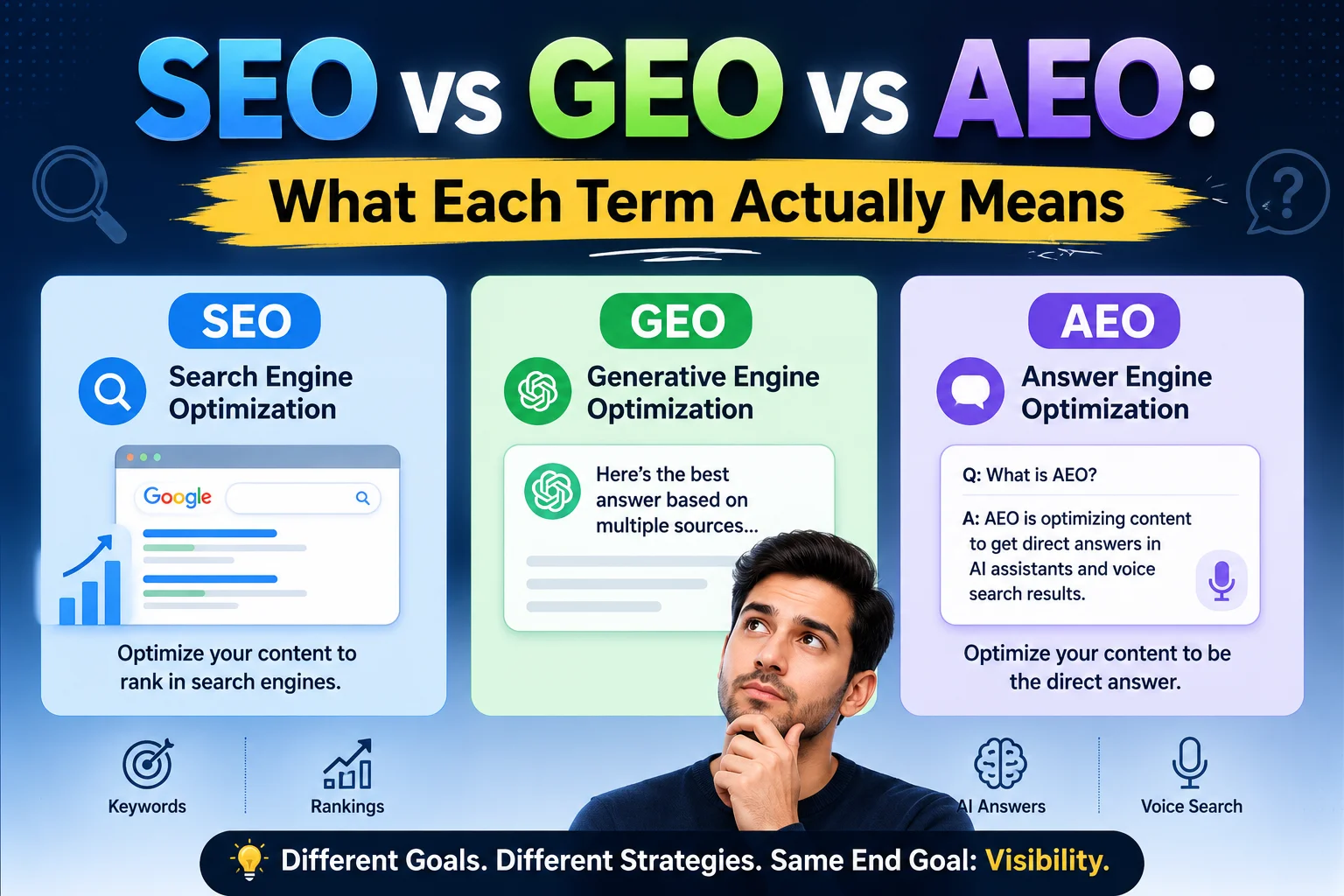
Here's a fact that should end this argument and won't.
Google and Microsoft — the two companies that actually operate the systems everyone is arguing about optimizing for — do not agree on what to call it. Google's official position, published in 2026 in documentation titled "Optimizing your website for generative AI features on Google Search," is that optimizing for generative AI search is optimizing for the search experience, and is therefore still SEO. Bing published a 16-page guide calling it AEO/GEO.
Same web. Same content. Same crawlers, more or less. Two vendors, two vocabularies, and an entire industry caught in between selling retainers named after whichever one they picked.
So let's adjudicate. Not list — adjudicate. Three terms, three verdicts.
GEO: substantive, and the only one with a receipt
Generative Engine Optimization is the only acronym in this fight that can produce a birth certificate.
The term was coined in "GEO: Generative Engine Optimization" by Pranjal Aggarwal, Vishvak Murahari, Tanmay Rajpurohit, Ashwin Kalyan, Karthik Narasimhan, and Ameet Deshpande — a paper presented at KDD '24 in Barcelona, with authors from Princeton, Georgia Tech, the Allen Institute for AI, and IIT Delhi. It's arXiv:2311.09735. You can read it.
That matters more than it sounds. GEO didn't emerge from a LinkedIn post or a product launch. It came from a group of researchers who noticed something structural: traditional search had two winners — users who found information, and search engines that sold ads. Content creators were the third party, trading indexing for traffic. Generative engines break that deal, because a synthesized answer doesn't need a click.
Whatever you think of the acronym, that observation is correct, and it's the actual thing everyone is anxious about.
The paper also did the work. GEO-bench tested roughly 10,000 queries across nine datasets, and found that specific interventions moved the needle: adding statistics improved visibility by about 41% on Position-Adjusted Word Count, quotation addition by 30–40%, with citing sources performing similarly. There's also the finding nobody quotes, which is the most interesting one — a 115.1% visibility lift for pages sitting at position five. The researchers called it the Equalizer Effect. Low-ranked, high-quality sources benefit disproportionately.
But. The "up to 40%" that gets stapled to every GEO sales deck is a maximum, not an average, achieved under favorable conditions in a simulated two-stage pipeline in 2023. It is not a promise about your blog. And the GEO that vendors sell in 2026 has drifted almost entirely away from the paper it's named after.
Verdict: substantive. It names a real phenomenon, it has a definition someone can be wrong about, and it has a benchmark. That's more than most marketing terminology ever manages. Survives.
AEO: a 2014 term wearing a 2026 costume
Answer Engine Optimization is presented to you as the newest thing. It is the oldest thing in this article.
AEO originated in the featured-snippet and voice-search era, when winning "position zero" meant getting pulled into Google's answer box instead of clicked through to. Alexa, Siri, the whole smart-speaker moment. Marketers figured out that formatting content as a direct answer could win the box. That was around 2014.
The term sat there for a decade doing very little. Then ChatGPT happened, and someone noticed there was an unused acronym lying around with "answer" in it.
Now ask the only question that matters: what does an AEO practitioner do that a GEO practitioner doesn't?
Nobody can tell you. In current practice, for anyone trying to get cited by ChatGPT, Perplexity, or AI Overviews, AEO and GEO describe the same activity. You're not choosing between competing strategies. You're choosing which word your team prefers.
And there are more where those came from: AIO, LLMO, GSO, AI SEO, Retrieval Optimization, and — I promise this is real — CEO, for chat-engine optimization. Wikipedia's entry notes flatly that no consensus definition distinguishing these terms had been established in the academic literature as of early 2026, and that they're used interchangeably in practitioner contexts.
Verdict: mostly vendor marketing. Not because the underlying work is fake — the work is real — but because AEO is a synonym with worse provenance. It's GEO with an older birthday and no paper. Two names for one practice is one name too many, and the market resolves that eventually. My bet: AEO doesn't survive 2027 as a distinct term. It gets absorbed, the way "inbound marketing" got absorbed.
SEO: the parent category everyone keeps trying to bury
Here's the awkward part for the acronym entrepreneurs.
Roughly 93.67% of Google AI Overview citations link to at least one top-10 organic result. Around 87% of ChatGPT citations match Bing's top-10. Jeremy Moser of uSERP put it as bluntly as anyone: 80% of GEO is good, fundamental SEO.
If nine out of ten AI citations come from pages that already rank, then the thing you're optimizing for is ranking, and we already had a word for that.
You will encounter research that seems to contradict this. Profound published findings widely repeated as "SEO only explains 4–7% of AI citations," with content quality driving roughly 93% of citation variance. It's been quoted everywhere, usually by people selling something.
Read the methodology. What Profound measured was backlinks and authority scores. Not technical SEO. Not on-page optimization. Not content quality, topical authority, or freshness. So the actual claim is "backlink metrics explain 4–7% of AI citations" — which is a genuinely interesting finding, and a completely different sentence from the one on the slide. Profound also sells a premium AEO tool, which doesn't make them wrong, but does mean they have a commercial interest in this being a distinct, measurable, purchasable discipline.
Verdict: substantive, and load-bearing. SEO is the parent, not the sibling. Site structure, crawlability, and authority still determine whether an engine can find and trust you at all. Everything else happens on top of that.
The problem underneath all three
Now the part that should worry you more than the vocabulary.
SparkToro's Rand Fishkin and Patrick O'Donnell ran an experiment asking whether AI tools are even consistent enough to produce valid visibility metrics. Six hundred volunteers ran 12 prompts through ChatGPT, Claude, and Google's AI tools nearly 3,000 times.
The finding: there's less than a 1-in-100 chance that any AI tool, asked the same question 100 times, will return the same list of brands in any two responses.
Sit with that. Not "rankings fluctuate." Not "results are personalized." The same prompt, the same tool, and the brand list is different essentially every time.
The whole AEO/GEO tooling category is built on measuring something that may not hold still long enough to be measured. Vendors are selling optimization for a system whose behavior they can't predict, using metrics derived from outputs that don't reproduce. As Momentic put it, the real question isn't what we call this thing — it's whether "this thing" exists as a coherent practice at all, or whether we're drawing a circle around a bunch of disconnected tactics and calling it a discipline because that's easier to sell.
I think it does exist. The Aggarwal paper demonstrates in controlled conditions that content can be deliberately optimized for AI visibility, and that's not nothing. But the honest version is: we have one good paper from 2023, an industry of tools built on non-reproducible measurements, and a vocabulary invented by people with inventory to move.
The verdict, plainly
SEO is the discipline. It always was. Google says so, the citation overlap data says so, and the fact that AI engines mostly cite pages that already rank says so loudest.
GEO is a real sub-discipline with a real paper and a real finding, currently being sold as something it isn't. Keep the word. Read the source.
AEO is a recycled 2014 label describing the same work GEO already describes. It exists because "we do GEO too" is harder to differentiate on than "we do AEO, which is different." It isn't.
And the argument itself has a cost that nobody in it seems to notice. Clients don't buy theological disputes — they buy certainty. If the industry can't explain what changed, buyers defer, and budget quietly moves to paid search, paid social, or whatever ad unit Google or OpenAI sells them next.
Three acronyms. One practice. Pick a word, explain it in one sentence to a CFO, and go do the work.














Comments 0
Leave a Comment
💬
No comments yet. Be the first to share your thoughts!