

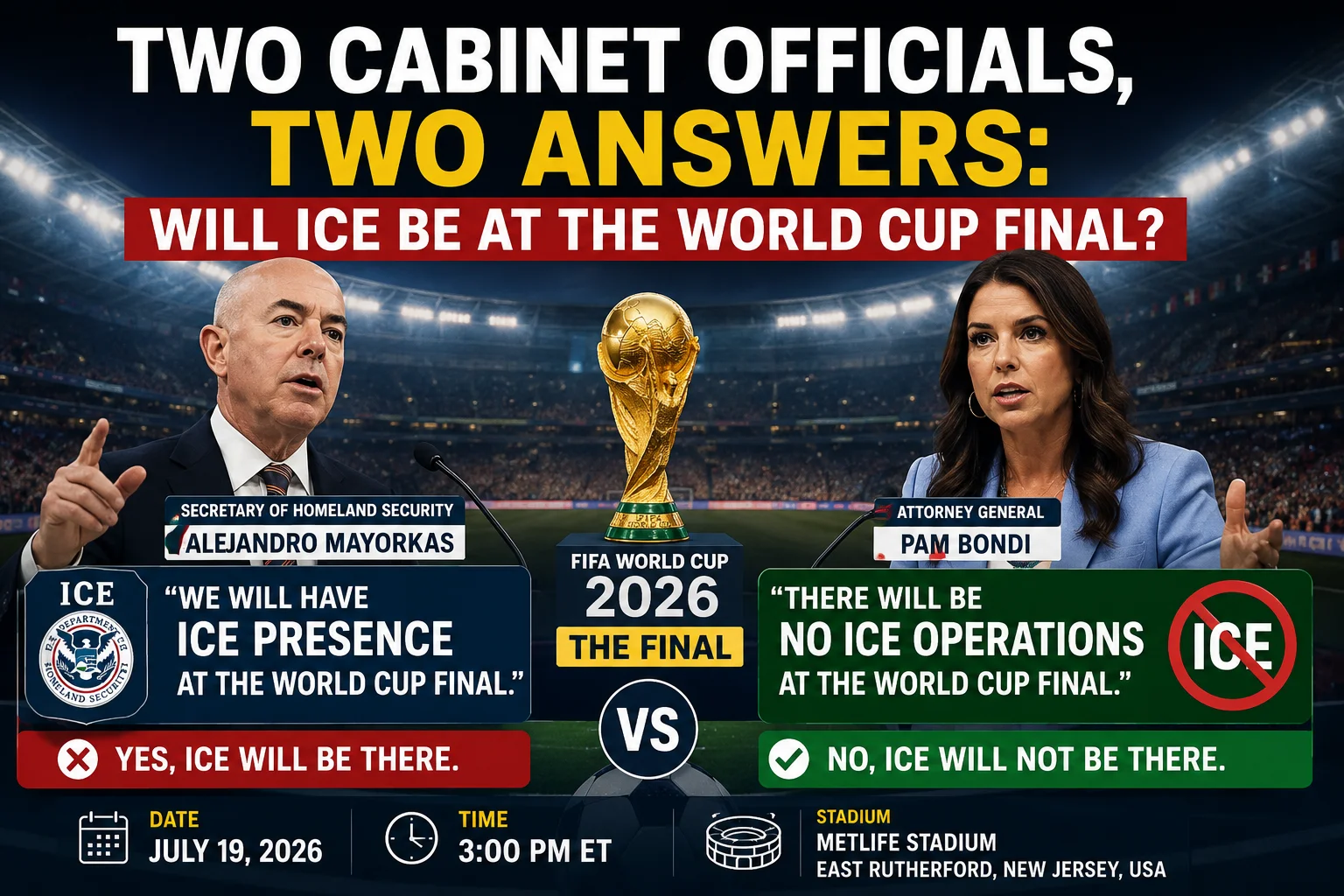
If you've searched some version of "will ICE be at the World Cup final," you've probably already run into the problem: the answers contradict each other, and they come from the government itself.
So here is what this article will and won't do. It will lay out exactly what named officials have said, on the record, with dates. It will tell you what has actually happened during the six weeks of the tournament now ending. It will explain the proposed law, the documented past incident, and what legal experts say fans can do. It will not predict what happens Sunday, because no one honestly can. Where sources conflict, you'll see the conflict rather than a paper-over.
Let's go.
The two answers
The confusion is not your imagination. Two members of the Trump cabinet gave opposite assurances within about a week of each other.
Secretary of State Marco Rubio, according to Miami's World Cup host committee, personally assured them that ICE would not be present at stadiums during the tournament. That was the message relayed to organizers.
Then, in an interview released by CBS News on May 13, Homeland Security Secretary Markwayne Mullin confirmed ICE agents would be at World Cup stadiums. His framing was that they'd be there mainly in a security role — not, in his words, "enforcing mass immigration" but to "enforce the law." Pressed on what agents would do if they encountered someone they considered a criminal, Mullin said that person would be arrested. He added the line that captures the whole ambiguity: "ICE always does immigration enforcement. We're always going to do that — but we're not there for solely that purpose." He said agents were "looking for the worst of the worst," not there to "round up mass individuals."
One official said not present. The other said present, in a security role, without ruling out arrests. Both statements are real. That is the actual state of the public record, and anyone claiming more certainty in either direction is filling a gap the government left open.
(One note on names, because it matters for accuracy: the DHS Secretary quoted here is Markwayne Mullin. Kristi Noem, who held the role earlier, was replaced; her more confrontational posture and Mullin's more discreet one are part of the story lawmakers tell about why enforcement stayed low-profile — more on that below.)
What actually happened during the tournament
Here is the context almost no viral version of this story includes, and it cuts against the alarm.
The World Cup has been underway since June 11. It's now ending. And by the account of the very lawmaker who raised the loudest early warnings, the feared enforcement wave did not materialize at the matches.
Representative Nellie Pou, the New Jersey Democrat whose district includes MetLife Stadium and who pressed ICE's acting director about this in congressional hearings, said about a week ago that she had not seen or heard of any significant, serious report of incidents — and that she was happy about it. She attributed the low-profile approach to congressional oversight and to the change in DHS leadership from Noem to Mullin, describing Mullin as having taken a more tempered and discreet approach.
That doesn't erase the concern, and Pou didn't say it did. But it's essential context: as the tournament reached its final week, the on-the-ground reality at the games had been quieter than the pre-tournament rhetoric on all sides suggested. A fair account has to hold both the alarming statements and the calmer outcome at once.
The number, and why you'll see more than one
You may have seen the figure "92,392 arrests." It's real, and it needs its context.
Human Rights Watch, analyzing ICE data, found that from January to October 2025, ICE arrested at least 92,392 people in and around the eleven US cities hosting World Cup matches. A later analysis, drawing on agency data released through a Freedom of Information Act request and covering January 20, 2025 to March 10, 2026, put the figure at approximately 167,000 across those same host-city areas.
Two numbers, two windows, same underlying point: large-scale enforcement has been ongoing in the metropolitan areas where the games are played. Neither figure describes arrests at stadiums or at matches — they describe the surrounding cities over many months. That distinction matters, and conflating "167,000 arrested at the World Cup" would be false. What the numbers establish is the environment around the tournament, not events inside the turnstiles.
The incident that started the questions
The reason immigration advocates flagged this at all is not hypothetical. It happened, at this stadium, at a FIFA event.
On July 13, 2025, at the Club World Cup final at MetLife Stadium, a father who is an asylum seeker took his two children — ages ten and fourteen — to the match. According to Human Rights Watch, police detained him and then turned him over to ICE. His children watched him taken away.
That single case is what transformed an abstract worry into a concrete one, and it's why the questions about Sunday's final at the same venue carry the weight they do. It's also, notably, a case that involved a handoff from local police to ICE — which is why the debate that follows centers so heavily on cooperation agreements.
The proposed law
In March 2026, Rep. Pou introduced the Save the World Cup Act, which would prohibit federal funds from being used for immigration enforcement within a defined radius of World Cup venues and FIFA Fan Festivals. Companion legislation from fellow New Jersey Democrat Rep. LaMonica McIver would extend those restrictions to public transit hubs and bar federally funded local law enforcement from taking part in immigration enforcement during the tournament period.
Be clear-eyed about status: these bills were not expected to advance in the current Congress, and as of this tournament they had not become law. They function more as a marker of the concern than as an operative restriction. Reporting that they "banned ICE from the World Cup" would be wrong — they proposed to, and didn't pass.
Human rights organizations went further, calling for an "ICE truce" during the tournament, invoking the ancient Olympic Truce tradition. A coalition including Human Rights Watch, Amnesty International and others also pressed FIFA and its sponsors to take a stand. FIFA built a human rights framework for 2026 with language about welcoming the world; critics argued it fell short on this specific issue.
What the administration says to visitors
In fairness to the government's position, DHS has been consistent on one message even amid the mixed signals about stadium presence.
A DHS spokesperson told Newsweek the agency would work with local and federal partners to secure the World Cup in line with federal law and the Constitution, as it does with every major sporting event, and that its mission was to ensure every fan had a safe experience. The spokesperson's key line for visitors: international visitors who legally come to the US for the World Cup have "nothing to worry about," and what makes someone a target is being in the country illegally — "full stop." Mullin separately said ICE and its investigative arm would work alongside Customs and Border Protection to address criminal activity like counterfeit goods and human trafficking.
Whether that reassurance satisfies you will depend on your own situation and how much weight you give the documented enforcement record versus the official statements. This article's job is to give you both, accurately, not to tell you which to believe.
What legal experts say fans can do
Practical, sourced guidance — not legal advice, and worth confirming with an immigration attorney for your specific circumstances:
Cory Forman, a New York-based immigration attorney quoted in local coverage, recommended that fans without legal immigration status reconsider their travel plans, and advised that other immigrant fans always carry documentation of their legal status with them. That's the concrete, oft-repeated counsel from attorneys in this space: carry your papers if you have them, and get individualized advice if your status is uncertain.
Beyond that, the general principles that apply at any large event apply here: know that entering an NFL-scale stadium involves security screening regardless of immigration questions, and that FanFests and transit hubs — the areas the proposed legislation specifically targeted — are separate from the stadium itself.
The honest bottom line
Will ICE be at the World Cup final? The government has not given a single, clear answer. A Secretary of State said no to one host committee; a Homeland Security Secretary said yes, in a security capacity, without ruling out arrests. That contradiction is the real, current state of the record.
What can be said with more confidence: enforcement has been extensive in host cities for over a year; a documented detention did occur at this stadium's last FIFA final; proposed protections did not become law; and, by the account of the tournament's most vocal congressional critic, the matches themselves stayed largely free of incident through the final week.
For most fans, Sunday will be a soccer game. For some, the questions above are not academic. Both of those things are true, and a clear-eyed reader deserves to hold them together rather than being sold either fear or false comfort.
This article summarizes public statements and reporting as of publication and is not legal advice. Immigration situations are individual; anyone with concerns about their status should consult a qualified immigration attorney. Officials' positions and enforcement policies can change; verify the latest before acting.













Comments 0
Leave a Comment
💬
No comments yet. Be the first to share your thoughts!