

It comes down to two teams.
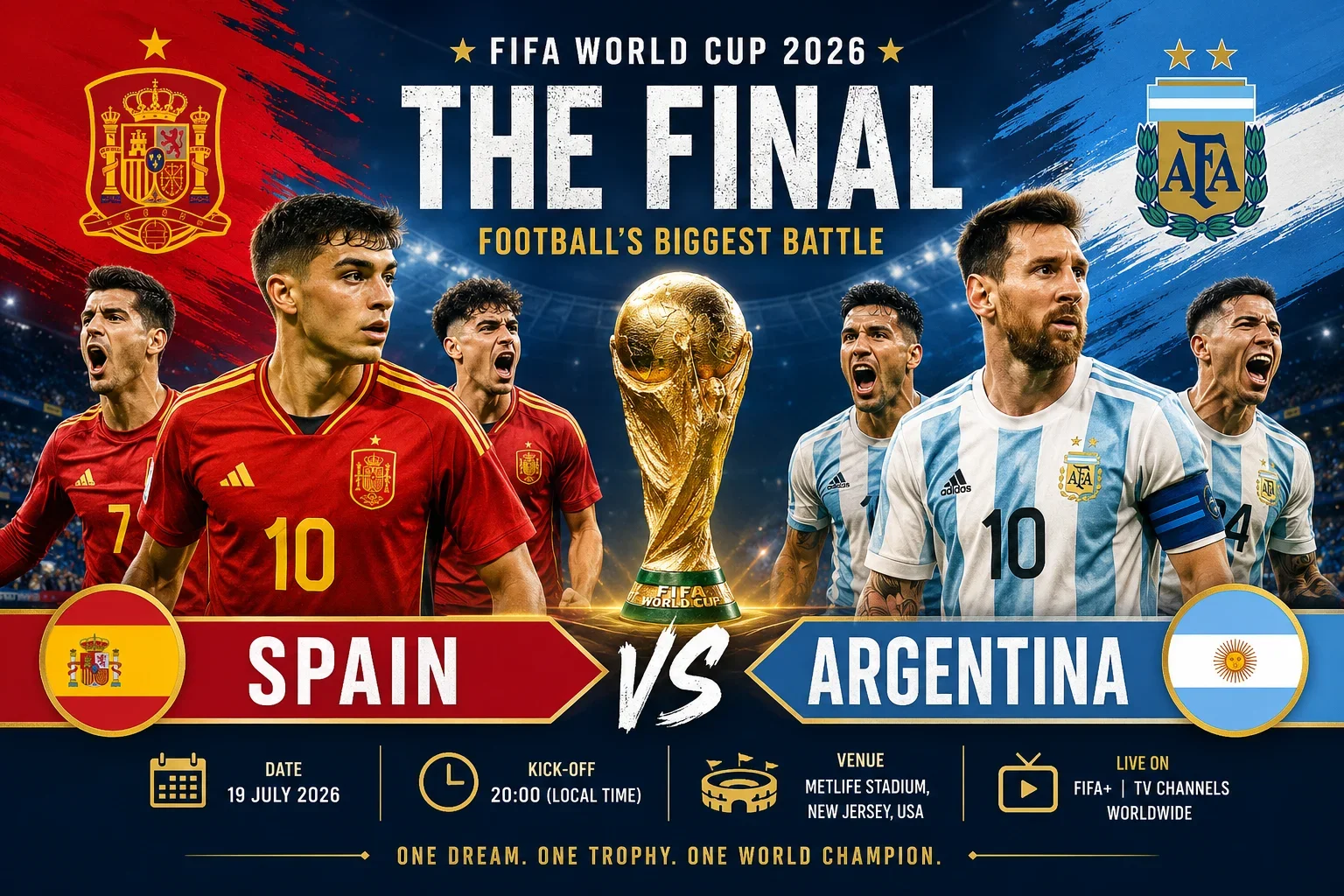
After six weeks, 48 nations, and more than 100 matches across the United States, Mexico and Canada, the 2026 World Cup has produced the final almost everyone wanted and nobody could quite believe would actually happen: Spain against Argentina. The reigning European champions against the reigning world champions. The best team in the tournament against the team that refuses to lose.
If you're just tuning in, here's the fast version, followed by everything underneath it.
The essentials
When: Sunday, July 19, 2026. Kickoff 3:00 p.m. ET (12:00 p.m. PT / 8:00 p.m. UK / 9:00 p.m. Central Europe).
Where: MetLife Stadium in East Rutherford, New Jersey — branded "New York New Jersey Stadium" for the tournament, normally home to the NFL's Giants and Jets. Expect a crowd north of 80,000.
What's at stake: Spain chasing a second world title, seeking to add it to the Euro they already hold. Argentina chasing a fourth star and back-to-back World Cups — something no team has done since Brazil in 1962.
The subplot everyone's selling: Lionel Messi, 39, almost certainly at his last World Cup, against Lamine Yamal, 19, playing his first. More on why that particular pairing is eerie in a moment.
How Spain got here
Quietly. Ruthlessly. Then, at the end, emphatically.
Spain opened with a scoreless draw against Cape Verde — the kind of flat first game that makes a nation nervous — and then simply stopped conceding. Six straight wins followed. They beat Portugal 1-0 to send Cristiano Ronaldo home, edged Belgium 2-1 in the quarterfinal, and dismantled France 2-0 in the semi, with Pedro Porro scoring the second in Arlington and Kylian Mbappé never getting going.
Here is the number that should worry Argentina, and it's not close to being a gimmick: Spain have conceded one goal in the entire tournament. One. That lone goal came against Belgium. Across six other matches — including knockout ties against Portugal and France — La Roja's net stayed empty.
Nobody wins a World Cup by accident, but Spain have won theirs by suffocation. Possession, patience, and a back line that has made world-class forwards look ordinary.
How Argentina got here
The hard way. Every single time.
Where Spain cruised, Argentina scrapped. They beat Egypt 3-2. They came through Switzerland 3-1. And in the semifinal against England in Atlanta, they did the thing that has defined this team for four years: they fell behind, and then Messi decided they wouldn't lose. Trailing 1-0, he orchestrated a late turnaround, assisting Enzo Fernández and then Lautaro Martínez for a 2-1 win.
ESPN's panel captured the mood around them perfectly — the sense that Argentina have found scrappy, unglamorous ways to win, proving you don't need to play well to keep advancing. They have not been the best team in this tournament. They may still be the hardest to beat, and those are not the same thing.
That's the final in one sentence. The tournament's best team against its most stubborn. Something has to give.
The matchup that decides it
Strip away the storylines and this is a genuinely fascinating tactical puzzle, because the two teams want opposite things from the ball.
Spain want it. All of it. Their game is territorial strangulation — long spells of possession, full-backs pushed high, the opponent pinned and starved. When Spain are good, you barely see the ball, and then it's in your net.
Argentina want you to have it. Their most dangerous moments come in transition — winning the ball and breaking at speed, with Messi drifting into the pockets where he can pick a pass and Lautaro running the channels. Sit them deep, let them absorb, and punish you the instant you overcommit.
So the final hinges on a single question: can Argentina live without the ball long enough to hurt Spain on the counter — and can Spain keep possession without leaving the space behind their high line that Argentina feast on? Spain's full-backs are their biggest weapon and their biggest risk. Every yard Porro and his opposite number advance is a yard of grass behind them for Messi to find.
Whoever wins that trade wins the World Cup.
Messi and Yamal: the photo that went around the world
You will hear this story roughly forty times before kickoff, so here's the real version.
Nearly twenty years ago, a young Lionel Messi posed for a promotional photo shoot holding a baby, after the baby's family won a charity raffle organized by a Spanish sports paper and UNICEF. The baby was Lamine Yamal. The picture resurfaced and went viral after Yamal's father shared it around the 2024 Euros.
On Sunday, the baby from the photo — now a 19-year-old widely regarded as the most exciting teenager football has produced in a generation — lines up against the legend who held him, for the first time in their careers, with the World Cup on the line. It is the kind of thing that would be dismissed as too neat if a screenwriter pitched it.
It's not really Messi vs Yamal on the pitch — they play different positions, different roles, for different teams. But as a passing of the torch made literal, it's hard to beat.
Head-to-head, and why history is thin
Here's a surprise: these two football giants almost never meet.
Their only previous World Cup encounter was the 1966 group stage, when Argentina beat Spain 2-1. Exactly sixty years later, they meet again with rather more on the line. Their most recent meeting of any kind was a March 2018 friendly in Madrid — and it's one Argentina would rather forget, a 6-1 Spain win. Messi didn't play. Read almost nothing into it; it was a friendly, a different era, and half the players on Sunday's teamsheets weren't there.
Who's favored
The models lean Spain, but not by enough to relax.
Opta's supercomputer gives Spain around a 45% chance in regulation, Argentina about 29%, with the rest going to a draw and the lottery beyond it. Live win-probability models tell a similar story — Spain favored, Argentina very much alive, and a real chance this goes to extra time or penalties.
And penalties are exactly where the neat narrative gets nervous. Argentina won their last World Cup on penalties, against France, in 2022. This is not a team that fears a shootout. Spain, for all their control, know that ninety minutes of dominance can be undone in twelve yards.
ESPN's Argentine correspondent picked Argentina 2-1, essentially on vibes and scar tissue — the sense that this group simply finds a way. The numbers disagree. Both can be true right up until the final whistle.
What to watch for if you only watch one thing
Watch Spain's full-backs. When they're high and Spain are humming, Argentina will be pinned and it'll look like men against boys. The moment Spain lose the ball with those full-backs upfield is the moment Messi's eyes light up. The entire final lives in that small, recurring gamble — and whoever blinks first probably loses.
The bottom line
This is the final the tournament earned. Not a mismatch, not a coronation — a real collision of styles, generations, and philosophies. Spain have been the best side in America for a month. Argentina have Messi, one last time, and a refusal to accept defeat that has already dragged them through England and out the other side.
Kickoff is 3 p.m. ET Sunday at MetLife. One team leaves as world champions. The other spends four years thinking about what happened in New Jersey.

















Comments 0
Leave a Comment
💬
No comments yet. Be the first to share your thoughts!