

Yes. He's playing. Let's get that out of the way first, because it's the thing the search bar keeps asking.
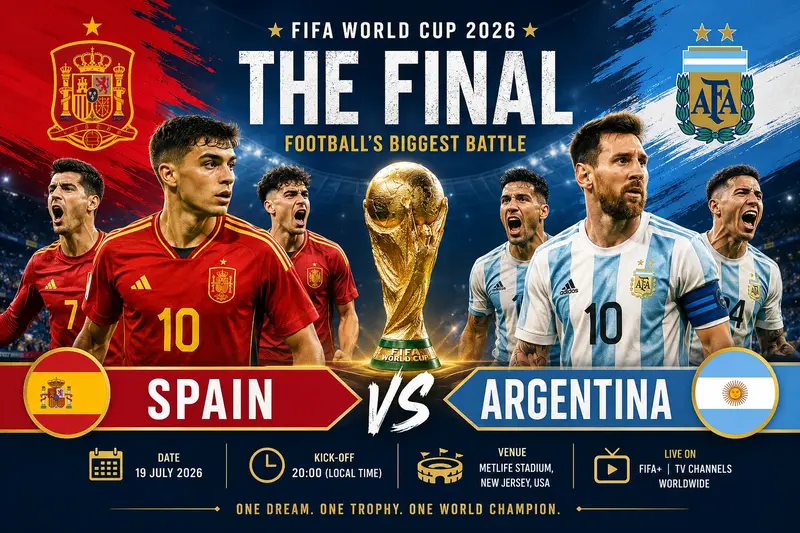
Lionel Messi will start Sunday's World Cup final against Spain. He is not injured, not rested, not a ceremonial substitute. Four days ago in Atlanta he set up both Argentina goals in a 2-1 comeback win over England — the equalizer for Enzo Fernández and, in the 92nd minute, the winner for Lautaro Martínez. At 39 years old, he is one match from a place in history that has been empty for 64 years.
Now the harder, more interesting questions. What exactly is at stake? What has he actually done at this tournament? And the one nobody quite says out loud: why is he still doing this at all?
The record that's been waiting since 1962
Here is the frame that makes Sunday enormous, and it's worth stating precisely, because it gets mangled a lot.
No nation has won back-to-back World Cups since Brazil did it in 1958 and 1962. That's it. Sixty-four years. Only two countries have ever managed it — Italy in 1934 and 1938, and that Brazil side.
What happened in between isn't just an absence of repeats. It's a graveyard. The reigning champion has failed and failed in almost every way a team can. Brazil's 1966 defense died in the group stage with Pelé kicked out of the tournament. The holders went out in the second group round in 1974, 1978 and 1982. Argentina's 1990 defense lost the final to a disputed late penalty. Brazil's 1998 defense dissolved in the final amid Ronaldo's mysterious pre-match illness. Then came the curse era — four straight champions (France, Italy, Spain, Germany) crashing out in the group stage, a pattern so reliable that federations grew superstitious about it. And France, in 2022, came within a penalty shootout of breaking the drought before losing the final to this same Argentina.
That's the wall Messi is standing in front of. If Argentina win Sunday, the question "has anyone repeated since 1962?" gets its first new answer in more than six decades.
A note on the captain angle, since you'll see it phrased loosely elsewhere: the neat line is that Messi could become the first player to captain a side to back-to-back World Cup titles. The reality has an asterisk worth respecting. Daniel Passarella, Argentina's only two-time winner, captained the 1978 triumph — but a stomach illness kept him out of the entire 1986 tournament, so he lifted one as captain and collected the other from a hospital-adjacent distance. Brazil's back-to-back was captained by two different men, Bellini in '58 and Mauro in '62. So the clean, true version is this: no one has ever captained a team through two consecutive World Cup wins as the on-field leader of both. Messi is 90 minutes from being the first.
What he's actually done at 39
This is where the story stops being sentimental and starts being absurd, because the numbers don't read like a farewell tour. They read like a peak.
Messi has scored eight goals at this World Cup — tied with Kylian Mbappé for the tournament lead — and added four assists. He opened his campaign, on his 200th international appearance, with a hat-trick. Through the knockouts he has been directly involved in an outrageous share of Argentina's goals, and in the semifinal against England he completed nine dribbles, the most by any player in a single match at the entire tournament.
The career totals have moved into territory that's hard to process. He is the all-time leading scorer in World Cup history with 21 goals. He now has 33 goal contributions in 33 career World Cup games — 21 goals, 12 assists — a combined tally no one else is close to; the next best in the tournament's entire history is Mbappé at 25. ESPN's stat line summed the gap between eras in three numbers: Messi 33, Mbappé 25; Messi's World Cup output dwarfing Pelé's and Maradona's on the raw contribution count.
And here's the detail that tells you what kind of player he's become. One analysis noted that Messi produced those eight goals and the assists despite spending nearly two-thirds of his time on the pitch walking.
That's not a criticism. That's the whole trick. He has traded the sprinting of his twenties for something rarer — a stillness that lets him read the game two seconds ahead of everyone else, then explode into the one moment that decides it. Against England he was, by most accounts, quiet for an hour. Then he won it in four minutes.
Why the comeback keeps happening
Argentina keep needing rescuing, and he keeps arriving. It's become the signature of the whole run.
Against Egypt in the round of 16, they staged an improbable late rally. Against England in the semi, they trailed to an Anthony Gordon goal and looked headed for extra time before Messi took the game by the throat. Argentina are now the first team ever to score multiple second-half stoppage-time winners in a single World Cup. They've gone to extra time more often than any team in history. They win ugly, they win late, and the constant is the 39-year-old who spends most of the match walking and the end of it deciding.
The question underneath it all
So: why is he still here?
He won everything in Qatar. In December 2022 he lifted the trophy that had defined and tormented his career, completed the one comparison the doubters still clung to, and could have walked away as the consensus greatest of all time with nothing left to prove. Most players would have. Many begged him to, if only to protect the perfect ending.
He didn't. And the honest answer to why is probably not a grand one. Through the qualifying campaign he kept refusing to confirm whether he'd even play in 2026, saying after one match in Argentina that it might be one of his last in front of the home crowd. He has spent years treating each appearance as possibly the final one, which is its own kind of answer: he keeps going because stopping is a decision, and he keeps declining to make it.
There's a version of Sunday that's almost unbearable to consider — that this genuinely is the last one, that a 39-year-old body has one more of these in it and no more. He has never said so directly. But "the last dance, for real this time" has hung over this entire tournament, and the reason it resonates is that everyone watching suspects it might be true.
What's left to prove? Nothing, by any reasonable measure. He's proven all of it. Which is exactly why the fact that he's still out there, still walking and watching and then deciding matches in the 92nd minute, is the most compelling thing about him now. He isn't chasing validation anymore. He appears to just… not want it to end.
What Sunday actually is
Strip away the mythology and it's a hard game against a great team. Spain have conceded one goal all tournament and are favored. Argentina have been the harder side to beat, not the better one. Messi will likely spend an hour looking like a man conserving something precious, and then, if the pattern holds, there will be one moment where the whole thing bends around him.
If it goes Argentina's way, a nation joins Italy and Brazil in the tiny club of repeat champions, and a 39-year-old does something no player has done in the sport's modern history. If it doesn't, the last image of Messi at a World Cup will be him losing a final to the next great teenager, which is its own kind of poetry, and a crueler one.
Either way, he's playing. Ninety minutes. Sixty-four years of history on one side of the scale, and on the other, a man who was supposed to be finished, still refusing to be.
Result-day variants (pre-built per your brief — drop in the correct one within minutes of the whistle)
IF ARGENTINA WIN — replace "What Sunday actually is" closing with:
He did it. Argentina are world champions again — the first nation to retain the World Cup since Brazil in 1962, and Lionel Messi, at 39, has captained a team through back-to-back titles in a way no player before him ever has. The man who spent most of the final walking finished it holding the only trophy that was ever in doubt, for the second time, when he never had to be here at all. Whatever comes next, there is now nothing — nothing — left on the list.
IF SPAIN WIN — replace closing with:
It wasn't to be. Spain are world champions, and Messi's final act at a World Cup was a defeat to Lamine Yamal's generation rather than a coronation of his own. The repeat stays unclaimed, 64 years and counting. If this was the last one — and he has never quite said — then he leaves as he arrived at the 2022 final: the greatest of all time, and, this time, on the losing side of the last match. The record he chased will wait for someone else. The career doesn't need it.











Comments 0
Leave a Comment
💬
No comments yet. Be the first to share your thoughts!