

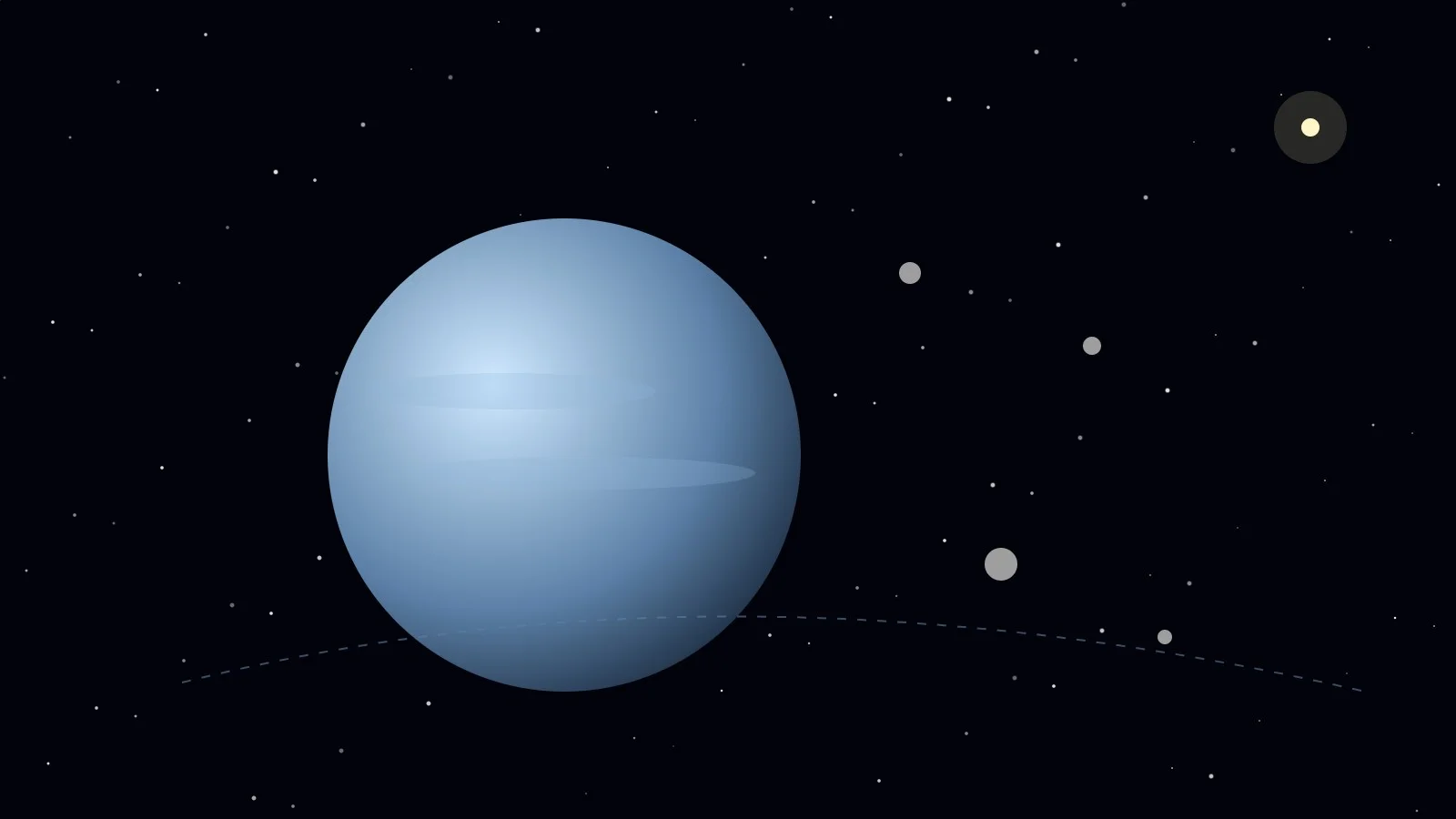
In short: A new study suggests our solar system may have a ninth planet we haven't seen yet. Computer simulations point to a world about 1.5 to 2 times the mass of Earth, nicknamed "Planet X2" (PX2), orbiting hundreds of times farther from the Sun than Earth. It hasn't been observed, but astronomers say a powerful new telescope could soon help find it, or rule it out.
What did scientists find?
The research, published on 23 November 2026 in the Monthly Notices of the Royal Astronomical Society, was led by Patryk Sofia Lykawka of Kindai University in Japan and the University of Southern Queensland, with Pedro Bernardinelli (University of Washington and University of São Paulo) and Jonti Horner (University of Southern Queensland). The study is titled "Signatures of an Earth-class Planet in the Distant Solar System".
The team didn't spot the planet through a telescope. Instead, they looked for its possible gravitational fingerprints. They ran simulations of how the outer solar system developed over about 4.5 billion years and found that some icy objects far beyond Neptune have unusual orbits, including extreme tilts and closest approaches beyond Pluto, that are best explained by an unseen planet.
What would Planet X2 be like?
- Mass: about 1.5 to 2 times Earth's mass.
- Orbit: an elongated path averaging roughly 350–500 times Earth's distance from the Sun (350–500 AU), never coming closer than about 200 AU.
- Conditions: out there, sunlight would be hundreds of times weaker than on Earth, so it would be a frozen, dark world.
"If this planet exists, it could change how we understand the history of our Solar System," Lykawka said.
How is it different from Planet Nine?
For years, some astronomers have proposed a hidden "Planet Nine" to explain odd orbits in the outer solar system. Planet Nine would be a substantially more massive world, several times heavier than Earth. Planet X2 is a smaller, more Earth-like alternative. Both remain hypothetical.
How could we find it?
The answer may come from the Vera C. Rubin Observatory in Chile. Its Legacy Survey of Space and Time is mapping the whole southern sky repeatedly, finding thousands of faint distant objects. Their orbits could confirm the patterns PX2 predicts, or even reveal the planet itself.
A busy time for the outer solar system
Rubin has already made headlines this autumn: it found 2026 ED138, an icy object beyond Neptune that could become the solar system's sixth recognised dwarf planet, after Pluto, Ceres, Eris, Haumea and Makemake, if its size and shape are confirmed.
Why it matters
Since Pluto was reclassified as a dwarf planet in 2006, Neptune has been the farthest known planet. Finding another planet would be one of the biggest astronomy discoveries in more than a century, and could reveal how the giant planets moved around in the early solar system.
Featured image: AI-generated illustration. Sources: University of Southern Queensland, Monthly Notices of the Royal Astronomical Society, Yahoo News, The Daily Beast, Universe Magazine, The News, National Geographic, Live Science and ScienceDaily, October–November 2026.



















Comments 0
Leave a Comment
💬
No comments yet. Be the first to share your thoughts!