

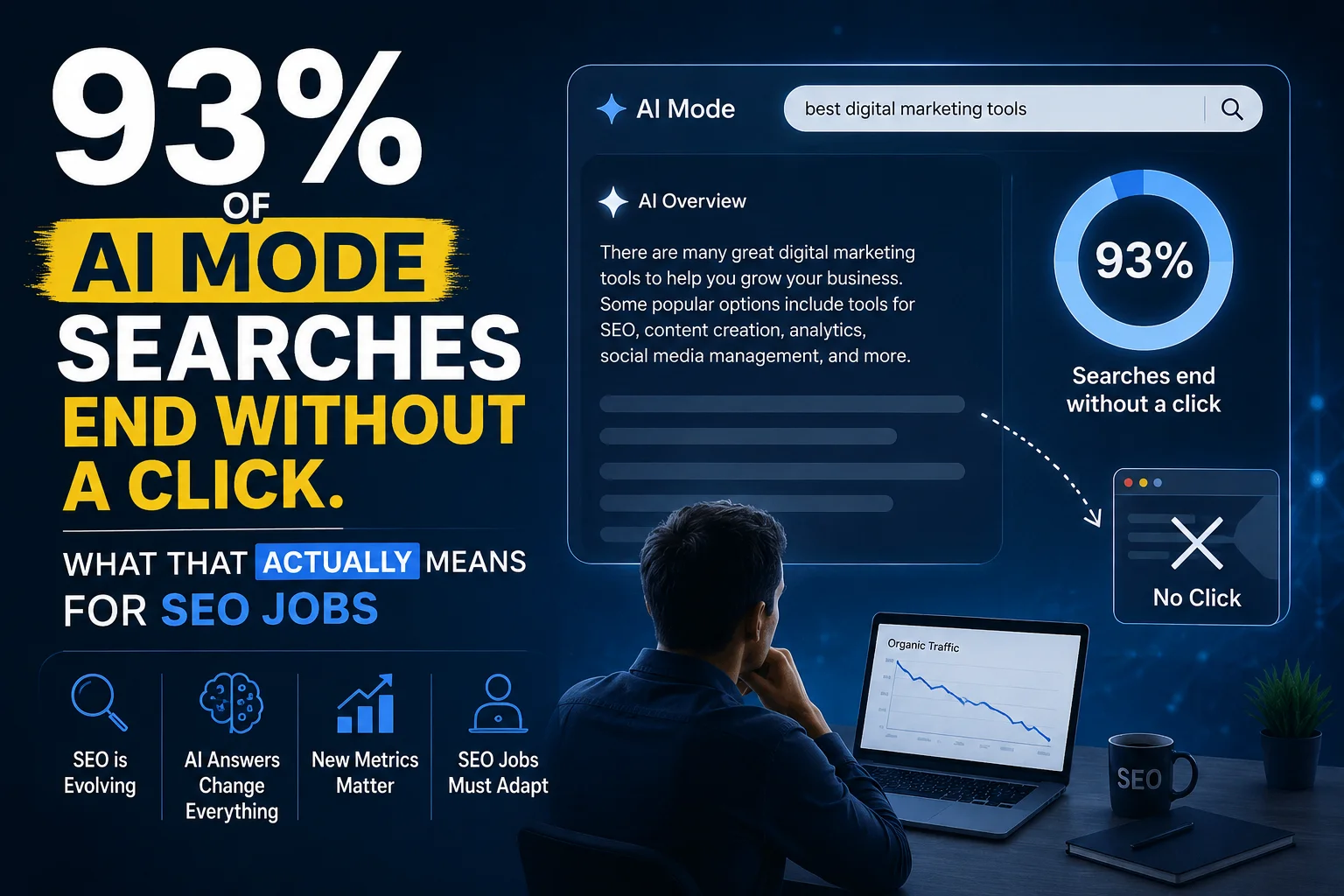
Let's start with the number everyone is quoting, because it's about to be quoted at you in a performance review.
Ninety-three percent of AI Mode searches end without a click to an external site. It's real. It shows up in Semrush's study of 69 million US desktop search sessions, and Seer Interactive landed on the same figure independently across 25.1 million impressions. Two methodologies, one answer. That's not nothing.
Now the part that gets cut from the LinkedIn posts.
Semrush's data was collected between May 1 and July 5, 2025 — a window during which AI Mode grew from 0.25% to 1% of all search sessions. Ninety-three percent of a rounding error. Those were early adopters: people who deliberately sought out an experimental conversational interface, presumably because they wanted a conversation rather than a website.
Today, AI Mode is the default. It passed one billion monthly users, with queries more than doubling every quarter since launch, and at I/O in May, Google made it the front door — replacing the search box with an AI-powered interface, information agents that monitor the web around the clock, and generative UI that builds custom tools on the fly.
Whether a behavior measured on 1% of sessions holds when that becomes 100% of sessions is an open empirical question. Nobody knows. Anyone telling you they do is selling an AEO retainer.
The number that actually predicts your job
Here's the thing about 93% as a career signal: it's an average, and averages hide the only thing you need to know.
Informational queries run about 74% zero-click. Transactional queries run 31%. And when researchers actually watched people search for high-involvement services — lawyers, dentists, contractors — 69% clicked through to a website, and 89% clicked multiple businesses, visiting an average of 3.7 sites in a session.
That's not a smaller version of the old search. It's a different shape. AI Mode builds a consideration set and then releases the user to go evaluate it.
So: if your entire job is producing content that answers "what is X" and "how to do Y," yes. That work is evaporating, and the 93% is your number. If your work touches anything someone has to decide, buy, or hire — the click is still there, and it's a better click than you used to get.
The HubSpot story you've been told is wrong
Every version of this article uses HubSpot as the corpse. "HubSpot lost 80% of its organic traffic to AI." It's the sentence that launched a thousand consulting decks.
It's shaky in three separate places.
First, the source. The figure came from Ahrefs panel data that circulated widely in early 2025 and was subsequently deleted. Third-party estimates of someone else's traffic, later withdrawn.
Second, HubSpot disputed it. Kieran Flanagan, their SVP of marketing, publicly pushed back on the "80% of its blog traffic" story, calling out how much of the reaction was overblown.
Third — and this is the one that should end the conversation — the timeline doesn't work. HubSpot's blog started losing rankings after the March 2024 Core Update and Spam Update. That's before AI Overviews had any meaningful footprint. What actually happened is that Google devalued high-volume, broad-topic content written by a company with no particular authority on the topic. HubSpot published enormous quantities of it. AI didn't kill that blog. A core update did, for reasons that would have been just as valid in 2019.
HubSpot's real, self-reported number is more useful and much less dramatic: organic traffic for its customers down 27% year over year, while AI referral traffic tripled.
Twenty-seven percent is a bad year. It is not an extinction event. And you should be suspicious of anyone who needed to inflate it to 80% to make their point.
What the hiring data says
This is where the doom narrative falls apart entirely, because you can just go look.
Semrush analyzed 3,900 SEO job listings and found that Director, VP, and Head-level roles account for 59% of the market — while SEO Specialist sits at 15% and SEO Manager at 10%. Read that as a warning, not a comfort. The market didn't shrink. It hollowed out in the middle. The execution rungs of the ladder are the ones being sawn off, which is a problem if you're standing on one, and a bigger problem for whoever's supposed to become a director in 2031.
The pay data is blunter. A separate analysis of 1,175 US SEO listings posted between April 2025 and March 2026 found that roles with AI in the job title pay a median of $113,625, versus $89,438 for roles without — a 27% premium that exists in the market right now. At Director level, the gap widens to $35,250. Meanwhile 54.9% of all listings mention AI somewhere in the description.
That's the whole story in two numbers. AI is in most job descriptions. It's in a minority of job titles. The premium is being paid for the gap between those two things — for people who can do the new thing on purpose rather than mention it.
New titles are being created outright: Experian posted an AEO & SEO Manager role at $100K–$174K, and senior content roles focused on AI optimization run $150K–$210K at enterprise companies.
Which parts of the job are actually automating
Be honest with yourself about which column you're in.
Automating now: bulk keyword-targeted content, rank tracking reports, first-pass technical audits, keyword grouping, manual link prospecting. These were always the parts of the job you could describe as a checklist, and anything you can describe as a checklist is a specification for the machine that replaces it.
Appreciating now: deciding what not to publish. Connecting search to revenue in a world where information agents and agentic checkout create conversions with no session, no UTM, and no trackable click path. Digital PR and citation-earning, which appears in about 13.5% of senior listings and matters more as AI systems pull from authoritative external sources. Structuring data so a machine can extract it — because if your comparison page buries feature data in paragraphs of marketing copy, generative UI can't pull it, and your competitor's clean table gets the citation instead.
Notice that last one isn't a content problem. It's a data architecture problem. That's the actual shift, and it's why the job is being priced at director level.
What to do in the next ninety days
Not a listicle. Three things, in order.
Learn to measure what you can no longer track. The measurement model is structurally broken, not temporarily inconvenient. If your reporting still rests on last-click, you are already reporting fiction, and you'll be blamed for the fiction before you're blamed for the traffic.
Move one rung up or one rung sideways. The middle is thinning. Sideways means the surfaces nobody has staffed yet — AI citation tracking, entity work, schema and structured data at scale. One agency CAIO put it plainly: teams that weren't already tracking AI Mode visibility now need to go bug product or procurement to get tracking established. Being the person who did that first is a job.
Time it. The listing data shows a sharp seasonal peak in January 2026, when 395 unique SEO roles were posted — more than double most other months. If you're moving, prepare in Q4 and go in January. If you're hiring, start in November before everyone else shows up.
The honest close
Google's own framing deserves one line, because it complicates the story in a way that's inconvenient for everybody: the company reports that people are searching more than ever, with queries hitting an all-time high last quarter. Demand isn't being destroyed. It's being redistributed — to a surface where you don't get a session, don't get a UTM, and might not get a click.
hat's genuinely worse for publishers. It is not obviously worse for practitioners, and the salary data says it's currently better for the ones who moved early.
SEO isn't dying. The version of it that could be done from a checklist is dying, and it was already dying before AI showed up — HubSpot's blog is the proof, and everyone's been reading that evidence backwards for two years.















Comments 0
Leave a Comment
💬
No comments yet. Be the first to share your thoughts!