

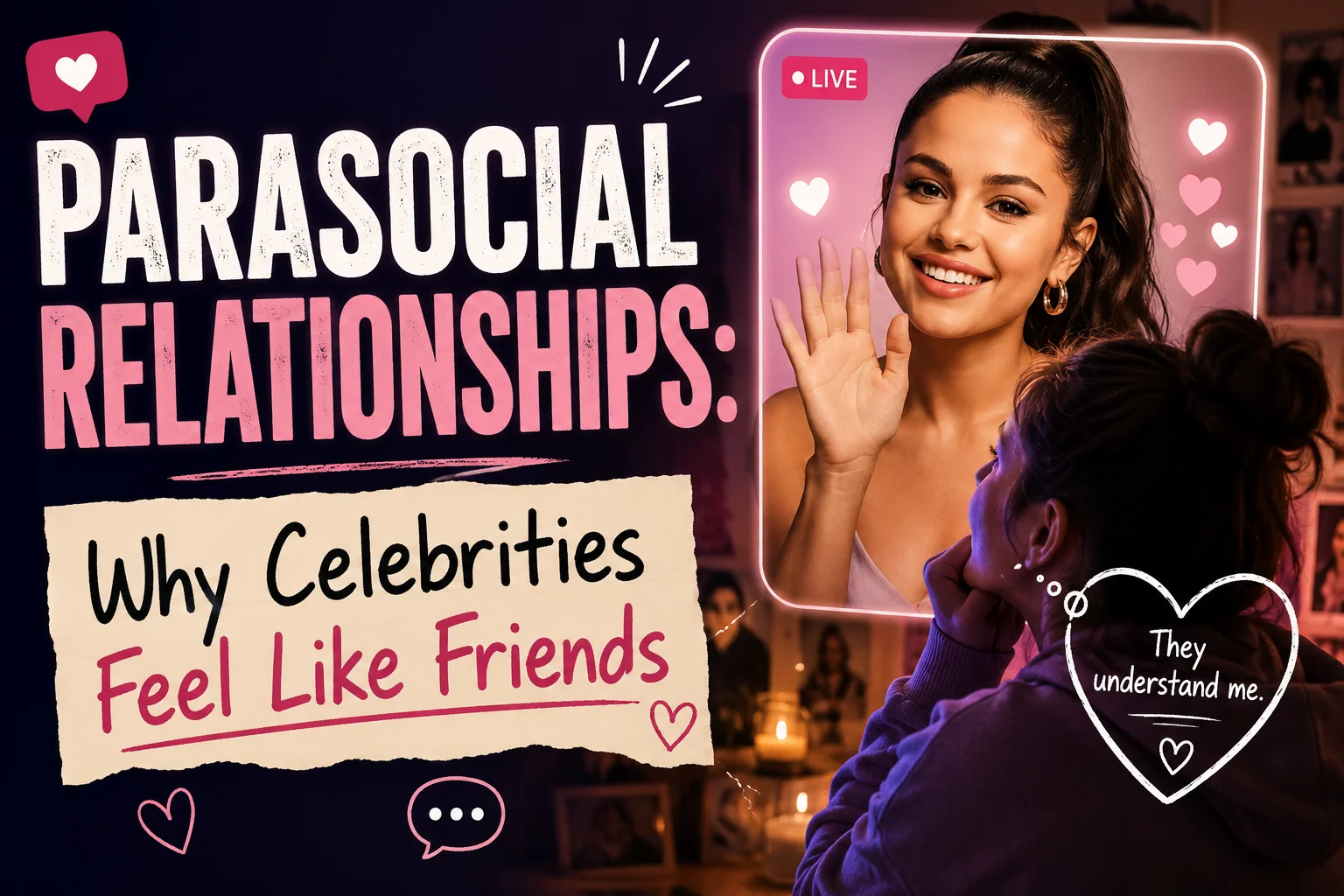
Here's a slightly uncomfortable thought experiment. Picture a celebrity, streamer, or musician you love. Now imagine you heard, right now, that they'd died. There's a good chance you'd feel a real pang of grief — genuine, not performed.
You've never met them. They have no idea you exist. And yet the feeling is real.
That's a parasocial relationship, and if it sounds a little embarrassing, it shouldn't. It's one of the most normal features of being a human with a screen, it has a name that's almost 70 years old, and understanding it explains an enormous amount about modern fame, fandom, and why the internet feels the way it does. Let's get into what it actually is — and, importantly, where the line sits between "completely normal" and "worth paying attention to."
What a parasocial relationship actually is
A parasocial relationship is a one-sided bond in which one person invests real emotional energy, time, and a sense of intimacy toward a media figure who is entirely unaware of them. You know them; they don't know you. The connection lives, as psychologists put it, only in the mind of the person experiencing it — which doesn't make it any less real to that person.
The classic version is the celebrity–fan bond, but the category is broader than that. It includes the connection people feel to a talk-show host, a favorite podcaster whose voice is in their ears every morning, a Twitch streamer they watch for hours, a novelist, even a fictional character. Anywhere a persona appears to you repeatedly and personally, but can't see you back, a parasocial relationship can form.
The key word is one-sided. A friendship is mutual: two people building a shared history together. A parasocial relationship feels like that from your side, but the other person isn't building anything with you. They're building it with an audience of millions, of which you are one invisible member.
It's older than the internet — by a lot
Here's the part that surprises people: this isn't a TikTok-era phenomenon. It was named in 1956.
Two American researchers, sociologist Donald Horton and R. Richard Wohl, were watching the then-new medium of television and noticed something. Viewers were forming bonds with the people on screen — talk-show hosts, announcers, personalities — as if they knew them personally. Horton and Wohl coined the term "parasocial" and gave it a phrase that's still the best three-word summary of the whole concept: "intimacy at a distance."
They pinpointed exactly how the illusion works. A skilled TV host looks down the barrel of the camera and addresses you. Over weeks and months, you accumulate a history with them — you learn their gestures, their voice, their opinions, how they react in different situations. You come to feel you know them the same way you know a friend: through observation over time. The catch, which Horton and Wohl named plainly, is that this accumulation of knowledge and loyalty stays entirely one-directional. The persona never learns a single thing about you.
That was radio and television. The mechanism they described in 1956 is the exact same one that powers a YouTube channel in 2026. Only the intimacy got more intense.
Why the internet made it so much more powerful
If parasocial bonds were possible with a 1950s TV host you saw once a week, social media poured rocket fuel on them. Three things changed.
The intimacy got closer. A film star was glamorous and remote. A modern creator films from their bedroom, tells you about their bad day, replies in the comments, does a Q&A, goes live. The content is deliberately personal and casual, engineered to feel like a friend talking directly to you — because that feeling is what builds loyalty (and, often, sales).
The frequency exploded. Horton and Wohl noted these bonds strengthen with repeated exposure. A creator might post daily, or stream for hours. You may "spend" more waking time with a favorite streamer than with some of your actual friends. Your brain, which evolved long before screens, registers all that familiar face-time as a real relationship.
The illusion of reciprocity got convincing. You can comment, like, follow, direct-message. Occasionally you get a reply or a heart, and it feels like contact. It is a tiny bit of contact — but it's the same tiny bit shared with everyone else, which the feeling conveniently ignores.
The result is that the line Horton and Wohl drew — you know them, they don't know you — has never been blurrier, or easier to forget.
The important part: this is mostly normal and often healthy
It's easy to write about parasocial relationships in a sneering, pathologizing way. Most coverage does. But the research doesn't support treating them as a problem by default, and the honest version matters.
For most people, most of the time, parasocial bonds are a normal, benign, even positive part of engaging with media. They can offer comfort, a sense of belonging, motivation, and a feeling of connection — particularly valuable during lonely stretches, life transitions, or isolation. There's a reason a familiar voice in your earbuds can genuinely make a hard day easier.
And crucially, the research pushes back on the biggest stereotype — that people with strong parasocial attachments are lonely loners substituting screens for a social life. One study of young adults found that the intensity of someone's parasocial relationships didn't meaningfully predict their well-being, and that people with strong parasocial bonds did not necessarily lack good real-life social support. In other words, these relationships often sit happily alongside a full social life rather than replacing it. Loving a creator doesn't mean you have no friends. Usually it just means you're a person who likes things.
So if you've ever felt faintly ridiculous about caring this much about someone who doesn't know you exist: you're describing the ordinary human response to modern media, not a character flaw.
When it does tip into unhealthy territory
That said, "usually fine" isn't "always fine," and the concept is genuinely useful precisely because it helps you spot the exceptions. The warning signs aren't about having the bond — they're about what it starts to cost you.
Watch for it when a parasocial relationship begins to:
Crowd out real ones. The concern researchers have flagged since the beginning is when the bond becomes a substitute that actively prevents forming or maintaining reciprocal, real-life relationships — rather than sitting alongside them.
Distort your grip on the reality of it. Feeling fond of a creator is normal. Feeling genuinely entitled to their time, their choices, or their personal life — reacting to their new partner or life decision as a personal betrayal — is the illusion overriding the facts.
Drive spending or behavior you can't afford, because the "friendship" feels like it obligates you to donate, buy the merch, or support the brand they're paid to promote. (This is not an accident. A whole field of influencer marketing exists because parasocial trust converts to sales better than advertising does.)
Cause real distress. If the relationship is a source of ongoing anxiety, obsession, or pain, that's the signal.
Handled healthily, the fix isn't shame — it's boundaries: enjoying the connection while keeping clear-eyed about its one-sidedness, prioritizing the reciprocal relationships in your actual life, and, if it's genuinely causing distress or interfering with daily functioning, treating that the way you'd treat any other source of distress — as something worth talking to a professional about.
The "parasocial breakup" — a real grief
One last piece, because it names an experience a lot of people have felt and couldn't explain.
Researchers describe the "parasocial breakup": the genuine sense of loss when a parasocial relationship ends. Your favorite show gets cancelled. A creator quits the internet. A beloved public figure dies. The grief that follows can feel disproportionate — why am I this upset, I didn't even know them — and people often feel silly about it.
You shouldn't. From your brain's perspective, you did have a relationship, built over real time through real emotional investment. The fact that it was one-sided doesn't make the history you experienced imaginary. Losing it is a real loss of something that was, for you, real. Naming it helps — it's a recognized phenomenon, not an overreaction.
The bottom line
A parasocial relationship is the one-sided bond you form with someone you know intimately and who doesn't know you at all — a phenomenon named in 1956 for television and supercharged by an internet built to make strangers feel like friends.
It's overwhelmingly normal. Often it's good for you. It only becomes a problem when it starts replacing your real relationships, distorting your sense of what you're actually owed, costing you money you don't have, or causing genuine distress.
The healthiest relationship with your favorite creator is the fully aware one: enjoy the connection, feel the things, and keep quietly in mind the one fact the whole experience is designed to make you forget — that on the other side of the screen, as warm as it feels, nobody knows your name. And that's okay. You're allowed to love things. Just love the people who can love you back a little more.
This article is general educational information about a psychological concept, not mental-health advice or diagnosis. If a relationship of any kind — parasocial or otherwise — is causing you significant distress or interfering with daily life, consider talking with a qualified mental-health professional.










Comments 0
Leave a Comment
💬
No comments yet. Be the first to share your thoughts!